Have you ever stood in front of a glowing panel and felt like you were staring into an endless tunnel of light? That mesmerizing effect comes from an infinity mirror—a clever optical illusion that creates the appearance of infinite depth using just two mirrors and some LEDs. Despite its futuristic look, the science behind it is surprisingly simple, relying on nothing more than repeated reflections and the human eye’s interpretation of fading light.
The infinity mirror uses a fully reflective back mirror and a partially transparent front mirror, with lights placed between them. As light bounces back and forth, each reflection loses a bit of brightness, making distant images appear dimmer and farther away. Your brain interprets this gradual fade as depth, crafting the illusion of a tunnel stretching far beyond the device’s physical limits. Whether used in art, décor, or science exhibits, this effect blends physics and perception in a way that continues to captivate.
In this guide, you’ll learn exactly how infinity mirrors work, what components make them tick, and why they create such a powerful illusion. You’ll also discover design variations, common misconceptions, and real-world applications from DIY projects to museum installations.
Core Components Every Infinity Mirror Needs
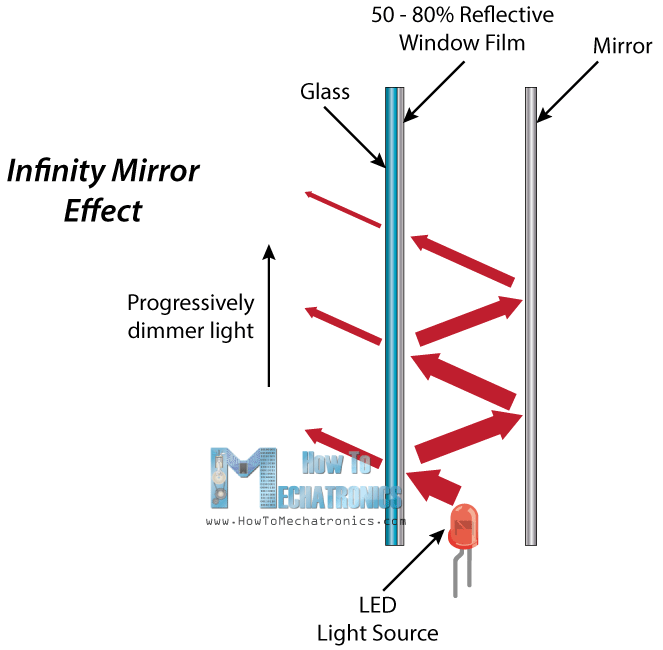
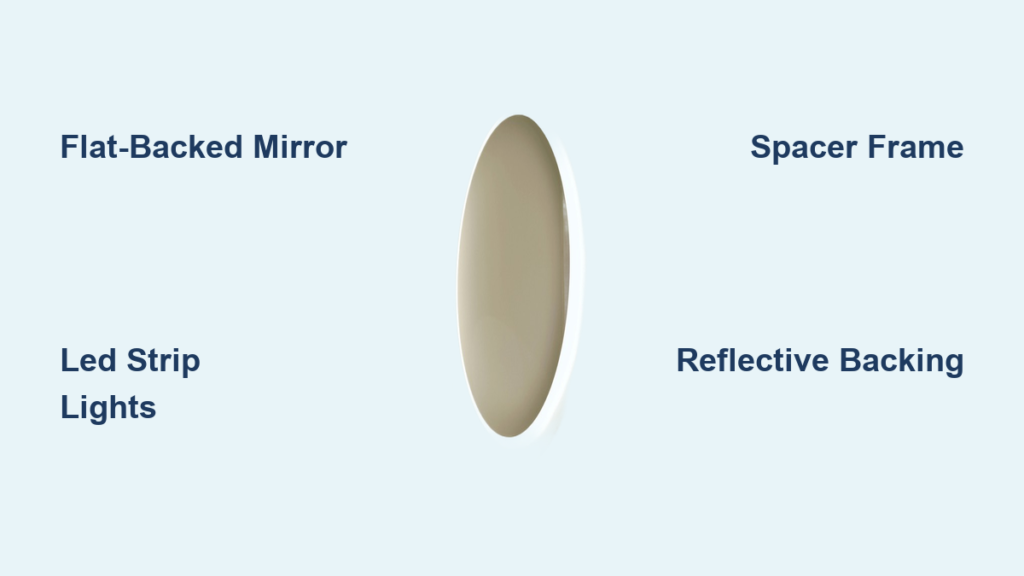
Every infinity mirror relies on four essential parts working together: two mirrors, a light source, and a frame. The magic happens not from any single component, but from how they interact.
Fully Reflective Back Mirror
This mirror sits at the rear of the assembly and reflects nearly all light back into the cavity. It’s typically made from silvered glass or mirror acrylic, with the latter being lighter and safer for large or portable setups. To maintain image clarity, the surface must be flat and scratch-free, as any imperfections distort the reflection chain.
Partially Transparent Front Mirror
Also known as a two-way or one-way mirror, this panel sits parallel to the back mirror and allows part of the light to pass through while reflecting the rest. This duality is key: it lets you see the reflected tunnel while preventing total light escape. High-quality see-through mirror acrylic offers a balanced 50 to 70 percent reflectivity, which is crucial for a deep, bright effect. If the material transmits too much light, reflections weaken. If it reflects too much, visibility drops.
LED Light Source
LEDs are mounted along the inner edge or within the frame, emitting light into the space between mirrors. Their low heat output and energy efficiency make them ideal for enclosed spaces. More importantly, modern RGB LEDs can be programmed to pulse, change color, or react to sound, adding dynamic movement to the illusion. The placement of LEDs shapes the visual pattern: edge-mounted strips create ring-like tunnels, while center-mounted arrays can project logos or custom designs.
Frame and Black Interior
The frame holds both mirrors in precise parallel alignment. Even a slight tilt disrupts the straight tunnel effect. Materials vary, wood, metal, or acrylic, depending on design needs. Crucially, the interior surfaces are painted matte black or lined with non-reflective material. This absorbs stray light, boosts contrast, and ensures only the intended reflections are visible.
The Science Behind the Endless Tunnel Effect
The infinity effect is not magic. It is physics. By controlling how light moves between two mirrors, we trick the eye into seeing depth where none exists.
Light Emission and First Reflection
When the LEDs turn on, light travels forward and hits the fully reflective back mirror. This mirror sends the light back toward the front, beginning the reflection cycle. At this stage, no tunnel is visible yet. Just raw light bouncing between surfaces.
Partial Reflection and Escape
As the reflected light reaches the front two-way mirror, something critical happens. A portion reflects back into the cavity, while another portion escapes through the surface. The escaping light is what your eye sees as the first visible ring or layer of the tunnel. Meanwhile, the reflected portion continues bouncing, setting up the next image.
Repeated Bouncing Creates Depth
Each time light hits the front mirror, another fraction escapes. These successive bursts of light form the next images in the sequence, each one dimmer than the last due to absorption by mirror coatings and minor imperfections. Because each reflection travels a longer path, the images appear progressively farther away.
Your brain interprets this gradual dimming and spacing as increasing distance, even though all reflections occur within a few centimeters. The result is a convincing illusion of infinite depth.
Why Reflections Fade and Shift Color
No mirror is perfect. Standard glass mirrors contain iron oxide, which absorbs red and blue wavelengths more than green. After several reflections, this selective absorption causes distant images to take on a greenish tint. Similarly, acrylic mirrors may introduce slight yellowing. These subtle shifts enhance the sense of depth, mimicking how real objects appear cooler and less saturated at a distance.
How Mirror Alignment Changes the Visual Result
Precise alignment is essential for a clean, straight tunnel. But intentional misalignment can create artistic distortions.
Parallel Mirrors for Straight Tunnels
When both mirrors are perfectly parallel, reflections form a linear, symmetrical tunnel. This setup is standard for most commercial and DIY infinity mirrors. Even a 1 degree deviation can cause the tunnel to curve or blur, so careful assembly matters.
Angled Mirrors for Curved Tunnels
Slightly tilting the front mirror bends the reflection path. Instead of straight lines, you see a spiraling or curved tunnel, a popular choice in art installations. Artists use this to add motion and unpredictability to the visual experience.
Flexible Front Surfaces for Swirling Effects
Using plastic two-way mirror sheets, you can gently bend the front surface. This warping distorts reflections into twisted, vortex-like patterns. Because glass cannot be safely curved without shattering, acrylic is the go-to material for these dynamic designs.
Popular Design Variations and Configurations

While the classic design uses one full and one partial mirror, creative configurations expand the possibilities.
Dual Two-Way Mirrors
Placing partially transparent mirrors on both ends allows light to escape from two directions. This creates a bidirectional infinity effect, visible from opposite sides. However, if the gap between mirrors is too narrow, reflections blur together instead of forming distinct layers.
Full Mirror Behind Two-Way Pair
Replacing the rear glass with a fully reflective mirror boosts brightness and increases the number of visible reflections. This setup intensifies the tunnel effect, making it appear deeper and more vivid.
Adjustable Spacing for Real-Time Control
Some experimental designs allow users to manually adjust the distance between mirrors. Pulling the front panel away stretches the tunnel, creating a live visual effect. This dynamic control turns the mirror into an interactive art piece.
Choosing the Right Materials for Your Setup
Not all mirrors or LEDs perform the same. The right materials make the difference between a dim blur and a stunning illusion.
Acrylic vs Glass
| Feature | Acrylic | Glass |
|---|---|---|
| Weight | Lightweight, easy to handle | Heavy, requires strong mounting |
| Safety | Shatter-resistant, ideal for homes | Can break, poses injury risk |
| Clarity | Slight optical distortion possible | Superior clarity and rigidity |
| Workability | Easy to cut, shape, and mount | Requires professional tools |
For most DIY and commercial uses, mirror acrylic wins due to safety and flexibility. Glass remains preferred for high-end installations where optical perfection is critical.
Optimal Reflectivity Ratio
The best two-way mirrors reflect 50 to 70 percent of light and transmit 30 to 50 percent. Too much transmission results in weak reflections. Too much reflectivity makes the front surface act like a regular mirror, hiding the tunnel. Finding the balance is key.
LED Placement Matters
LED placement dramatically affects the final look. Edge-mounted LEDs create concentric rings, the classic infinity look. Center-mounted LEDs project shapes or logos into the tunnel. Patterned arrays enable complex animations and interactive effects. Deeper frames allow more reflections before light fades, increasing perceived depth. A minimum of 1 to 2 centimeters is recommended.
The History and Cultural Significance of Infinity Mirrors
The infinity mirror is not just a modern gadget. It has deep philosophical and artistic roots.
Ancient Inspiration: Fazang’s Ten Mirrors
In 7th-century China, Huayan Patriarch Fazang used ten mirrors arranged around a Buddha statue, one on each wall, floor, and ceiling. When lit, the image repeated infinitely, symbolizing the interconnected nature of reality in Buddhist thought. This early use of recursive reflection predates modern optics by centuries.
Modern Art: Yayoi Kusama and Beyond
Contemporary artists like Yayoi Kusama have brought infinity mirrors into mainstream culture. Her immersive installations, such as Infinity Mirrored Room, surround viewers with endless lights, dissolving boundaries between self and space. Other artists, Josiah McElheny, Ivan Navarro, and Anthony James, use the effect to explore themes of identity, time, and the cosmos.
Musical Parallel: Spiegel im Spiegel
Composer Arvo Pärt‘s 1978 piece Spiegel im Spiegel mirrors the infinity effect through repetitive, layered piano and violin phrases. The music’s meditative structure echoes the visual recursion, showing how the concept transcends media.
Real-World Applications and Uses
From homes to nightclubs, the infinity mirror’s visual impact makes it versatile.
Home Décor and Wall Art
Used as statement pieces in living rooms or hallways, these mirrors add ambient glow and make small spaces feel larger. Available in round, hexagonal, or custom shapes, they can match any interior style. RGB options let users change colors via remote or app.
Retail and Commercial Displays
Jewelry stores and fashion boutiques use infinity mirrors to highlight products with dramatic depth. The glowing tunnel draws attention and enhances perceived value. Some displays integrate rotating platforms or motion-activated lighting for added engagement.
Nightclubs and Entertainment Venues
Integrated into dance floors, ceilings, and bars, infinity panels create immersive environments. Paired with sound-reactive LEDs, they pulse and shift with the music, amplifying the energy of the space.
Museums and Interactive Exhibits
Science museums like the Exploratorium use infinity mirrors to teach optics. Art tours like Yayoi Kusama: Infinity Mirrors have drawn millions, proving the effect’s broad appeal. Educational versions often include labeled diagrams to explain the science behind the illusion.
Building Your Own Infinity Mirror
Creating your own infinity mirror is a rewarding project that combines electronics, optics, and craftsmanship.
Step 1: Cut the Back Mirror
Use silver mirror acrylic or glass, cut to fit your frame. For acrylic, a fine-tooth saw or laser cutter works best. Sand edges smooth and inspect for scratches.
Step 2: Build the Frame
Construct from wood or acrylic. Depth should be at least 2 centimeters to allow multiple reflections. Paint the inside matte black to eliminate stray light.
Step 3: Install LED Strip
Mount an RGB LED strip along the inner edge. Connect to a power supply and controller. Test brightness and color modes before final assembly.
Step 4: Cut and Mount Front Mirror
Use see-through mirror acrylic, cut to size. Install with the reflective side facing inward. Secure firmly to maintain alignment.
Step 5: Assemble and Seal
Align both mirrors perfectly parallel. Use spacers if needed. Seal gaps with black tape to prevent light leaks.
Step 6: Power On and Adjust
Turn on the LEDs and fine-tune brightness to balance visibility and depth. Adjust color modes for mood or theme. Check mirror alignment if the tunnel appears crooked.
Common Misconceptions About Infinity Mirrors
Let us clear up some widespread misunderstandings.
The Tunnel Is Not Actually Infinite
Reflections fade after 10 to 20 bounces due to light loss. Beyond that, the human eye cannot detect the dim images. The tunnel is finite but appears endless.
You Do Not Need Special Materials
Standard mirrors and LEDs create the effect. No exotic components are required. Just proper alignment and lighting.
Two-Way Mirrors Work Best in Bright Conditions
They work best when the mirror interior is brighter than the surroundings, just like how windows reflect at night. They can function in lit rooms if the LEDs are bright enough.
Glass Is Not Always Superior
While glass offers better clarity, acrylic is often better for practical reasons: lighter, safer, and easier to shape. For most applications, the trade-off is worth it.
How Infinity Mirrors Compare to Similar Visual Effects
The infinity mirror shares concepts with other visual phenomena, but each works differently.
Droste Effect
A picture that contains a smaller version of itself, repeating infinitely. Unlike the optical infinity mirror, this is a digital or illustrative loop, not a physical reflection.
Kaleidoscope
Uses angled mirrors to create radial symmetry from colored fragments. It produces patterns, not depth.
Corner Reflector
Three perpendicular mirrors reflect light directly back to its source, used in safety gear and optics. No tunnel illusion.
Pepper’s Ghost
Projects ghostly images using a partially reflective surface, like in haunted house illusions. Shares the use of two-way mirrors but serves a different purpose.
Maintaining Your Infinity Mirror for Years of Use
Keep your infinity mirror looking sharp with simple care.
Cleaning the Surface
Use a microfiber cloth and non-abrasive cleaner. For acrylic, avoid ammonia-based products, as they can cause clouding or cracking.
Handling and Durability
Acrylic resists shattering and is safe for homes with kids or pets. Glass units need secure mounting and careful handling.
LED Longevity
Modern LEDs last 25,000 to 50,000 hours. Choose modular designs so you can replace strips if needed. Many commercial units include 1 to 3 year warranties.
Frequently Asked Questions About Infinity Mirrors
What makes an infinity mirror appear infinite?
An infinity mirror appears infinite because light bounces repeatedly between a fully reflective back mirror and a partially transparent front mirror. Each bounce reduces light intensity slightly, and the human eye interprets this gradual dimming and increasing spacing as depth. The reflections continue until light becomes too dim to detect, creating the illusion of endless space.
Can I make an infinity mirror with regular mirrors?
Yes, you can create an infinity mirror using standard mirrors. You need one fully reflective mirror and one two-way or one-way mirror. The key is proper alignment and a light source between them. No special or exotic materials are required.
Why do infinity mirrors sometimes look green?
Standard glass mirrors contain iron oxide impurities that absorb red and blue wavelengths more efficiently than green. After multiple reflections, distant images gradually shift toward green. This color change actually enhances the depth illusion by mimicking how real objects appear cooler and less saturated at a distance.
Do infinity mirrors work in lit rooms?
Infinity mirrors work best when the interior is brighter than the surrounding room, similar to how windows reflect more at night. In brightly lit rooms, the effect weakens unless the LEDs are sufficiently powerful to outshine ambient light.
How deep can an infinity mirror really look?
The perceived depth depends on the number of visible reflections before light fades, typically 10 to 20 bounces. A 2-centimeter thick mirror can appear to extend several meters deep. The actual physical depth is multiplied by the reflection count, creating a convincing illusion of vast space.
Key Takeaways for Understanding Infinity Mirrors
The infinity mirror is more than a visual trick. It is a fusion of science, art, and perception. By understanding how light, mirrors, and the human eye interact, you can appreciate not just how it works, but why it captivates us.
The core principle is simple: light trapped between two mirrors bounces repeatedly, with each reflection losing brightness and appearing farther away. Your brain interprets this pattern as infinite depth. The quality of materials, precision of alignment, and placement of LEDs determine whether the effect is stunning or underwhelming.
Whether you are building one at home, standing inside a Kusama installation, or simply admiring one in a nightclub, you are experiencing a timeless illusion that turns finite space into a window on infinity. The beauty of infinity mirrors lies in their accessibility. You do not need advanced physics knowledge or expensive equipment to create this effect. With basic components and careful assembly, anyone can bring this captivating visual phenomenon into their own space.