Choosing the right vanity mirror height isn’t just about looks. It’s about function, comfort, and daily usability. A poorly placed mirror forces you to tilt your head, miss key facial details during grooming, or disrupt the entire visual balance of your bathroom. The ideal vanity mirror height centers around one golden rule: align the center of the mirror with eye level, typically 60 to 65 inches from the floor for most adults.
But that is just the starting point. Your sink type, ceiling height, user height, lighting, and even accessibility needs all play a role in determining the perfect placement. This guide breaks down exactly how tall your vanity mirror should be with actionable guidelines, real-world examples, and pro tips to avoid common mistakes.
Center the Mirror at Eye Level for Optimal Visibility
The most reliable rule for vanity mirror height is simple: center the mirror at eye level. This ensures you see your full face without straining your neck or adjusting your posture.
Why Eye Level Matters
When the center of the mirror aligns with your eyes, you get a natural, distortion-free view of your face. This is crucial for tasks like shaving, applying makeup, or skincare. If the mirror is too high, you will be looking up. If it is too low, you will hunch down. Both cause discomfort over time.
Standard eye level measurements include:
- 60 to 65 inches from the floor for most adults
- Best for average height users between 5’4″ and 5’10”
- Ideal for standard vanity countertops 32 to 36 inches tall
Pro Tip: Measure the primary user’s eye level while standing in front of the vanity. This is the most accurate way to customize placement.
Adjust for Height Differences in Shared Bathrooms
In shared bathrooms, compromise is key. If one person is significantly taller or shorter, consider these solutions:
- Mount the mirror at 60 to 62 inches as a middle ground
- Use a taller mirror (30 to 36 inches high) to increase the visible range for both users
- Install a secondary lower mirror or tilting mirror for children or shorter users
Real-World Example: A couple with a 5’1″ and 6’2″ user found success with a 32-inch-tall mirror centered at 61 inches. This gave both clear visibility without constant adjustment.
Position Mirror 5 to 10 Inches Above Countertop
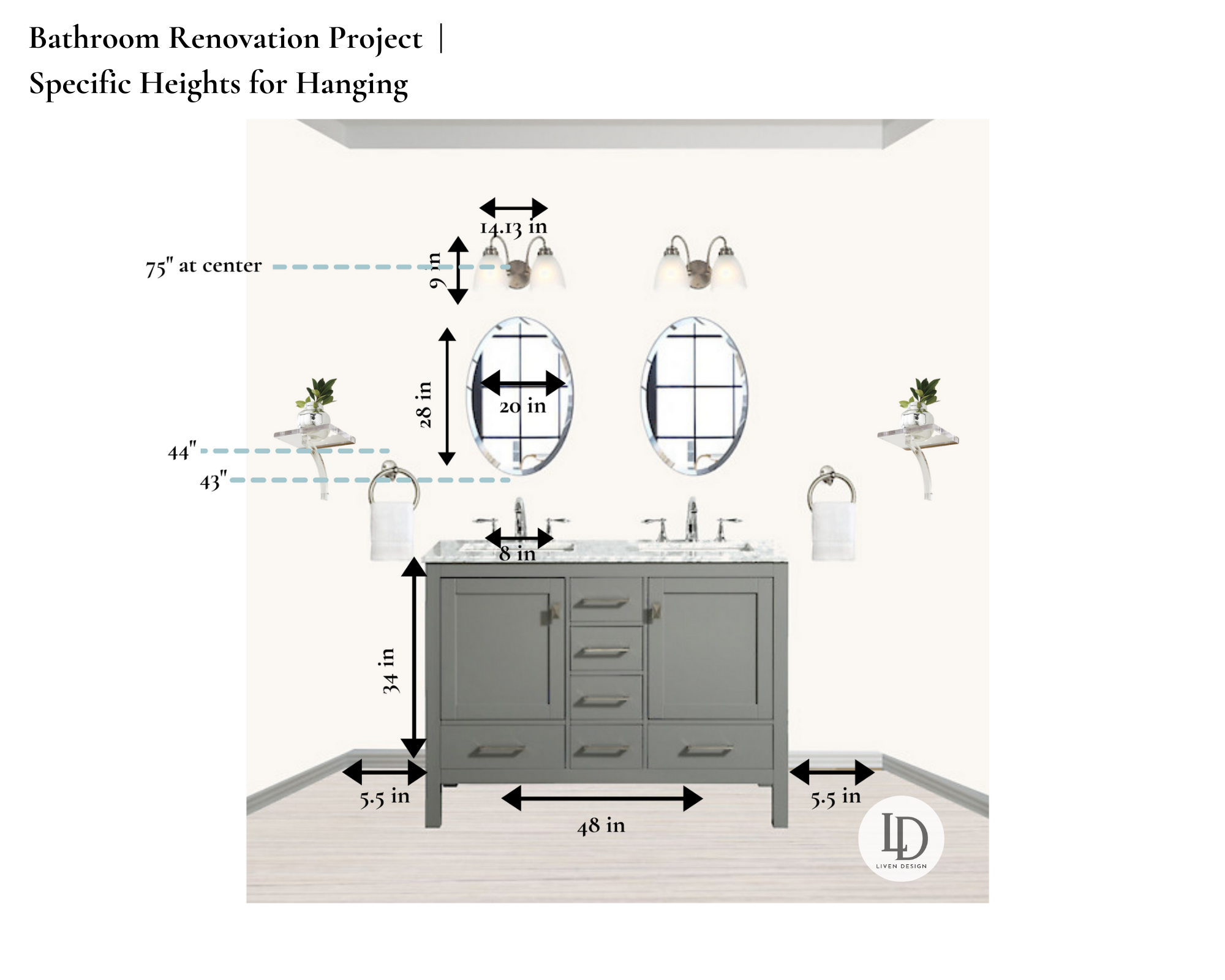
The vertical gap between your vanity top and the mirror’s bottom edge is just as important as overall height. This spacing prevents water damage, maintains visual balance, and ensures full facial visibility.
Standard Clearance Guidelines
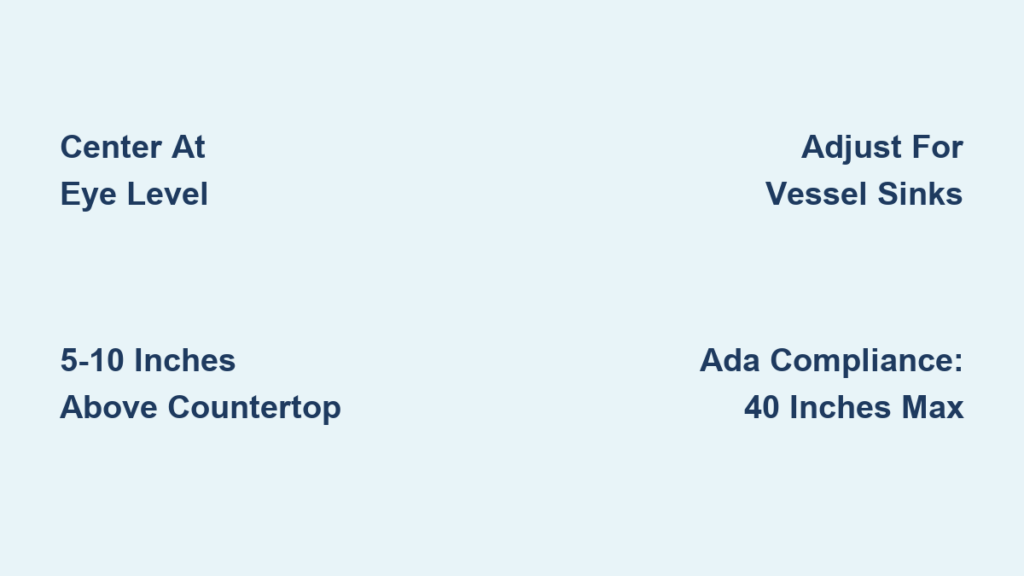
The recommended gap between the countertop and the bottom of the mirror is 5 to 10 inches (12.7 to 25.4 cm). This range accomplishes several goals:
- Prevents water splashes from hitting the mirror
- Allows full facial visibility without obstruction
- Maintains visual balance with the sink and faucet
Warning: If the mirror is too close to the faucet, you risk hitting your head or spraying water onto the glass.
Adjust for Sink Type
Not all sinks are created equal. The type of sink you have affects how high or low you should mount the mirror.
Vessel Sinks Require Lower Mounting
Because vessel sinks sit on top of the counter and are taller than standard sinks, users stand farther back and at a higher angle.
- Mount mirror 3 to 6 inches lower than usual
- Aim for bottom edge 4 to 8 inches above countertop
- Keeps the center of the mirror at proper eye level
Example: A 36-inch-tall vanity with a 5-inch-tall vessel sink effectively raises the user’s working height. So the mirror must be lowered to compensate.
Pedestal and Wall-Mounted Sinks
- Pedestal sinks: Center mirror over the basin, maintaining 5 to 10 inches clearance above the fixture
- Wall-mounted sinks: Ensure mirror does not interfere with arm movement. Center at eye level, not sink height
Customize Mirror Height for Standing vs. Seated Use
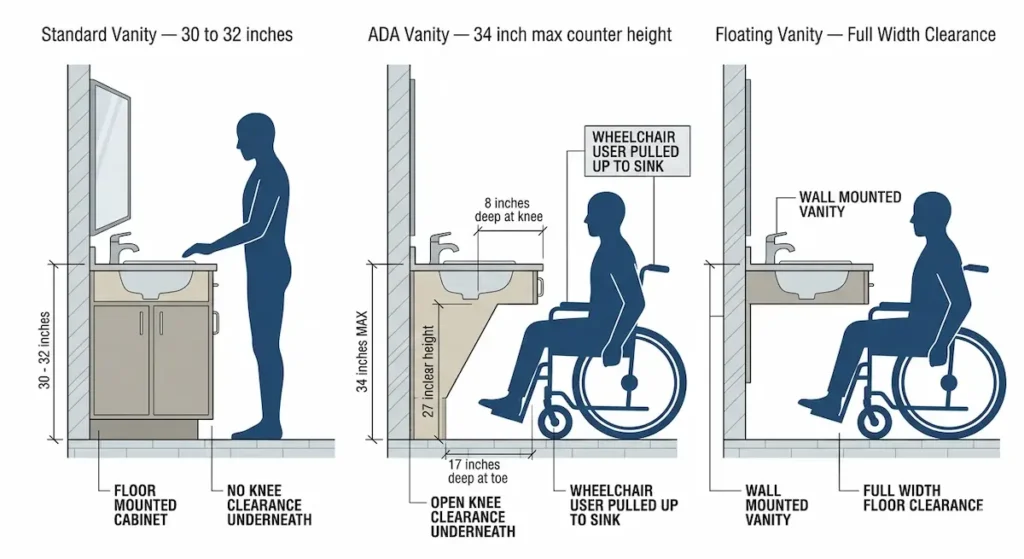
Mirror height changes depending on whether you are standing or sitting. Do not assume one size fits all. Posture matters significantly.
Standing Vanity (Bathroom Sink)
For standard bathroom vanities where users stand:
- Center of mirror: 60 to 65 inches (ideal for most adults)
- Taller users (6’+): Raise to 66 to 68 inches
- Shorter users (under 5’4″): Lower to 56 to 58 inches
- Family bathrooms: Use a taller mirror (30 to 36 inches) to serve multiple heights
Pro Tip: Test with painter’s tape. Cut out a paper template of your mirror and tape it to the wall at different heights to see what feels right.
Seated Vanity (Makeup or Dressing Table)
For grooming while seated, mirror height shifts dramatically.
- Desk height: 28 to 30 inches
- Chair/stool height: 18 to 22 inches
- Seated eye level: 54 to 62 inches from the floor
- Center of mirror should align with seated eye level
Critical Step: Sit in your actual chair and measure your eye height before mounting. A mirror that is perfect standing up may be useless when sitting.
Expert Note: Lighting is even more critical here. Pair your seated mirror with side sconces or a Hollywood-style ring light for shadow-free illumination.
Follow ADA Guidelines for Accessibility
If accessibility is a priority, whether for aging in place, mobility challenges, or universal design, follow ADA standards. These guidelines ensure everyone can use the mirror comfortably.
ADA Mirror Height Requirements
- Bottom of reflective surface must be no higher than 40 inches from the floor
- Allows visibility for seated users, including those in wheelchairs
- No center-at-eye-level rule here. The focus is on low enough placement for all users
Design Solution: Use a tilting mirror, adjustable-arm mirror, or lower full-length mirror to meet ADA needs without sacrificing style.
Common Mistake: Installing a standard-height mirror in an accessible bathroom. This defeats the purpose of universal design.
Match Mirror Height to Ceiling Height for Visual Proportion

High ceilings can make a standard mirror look undersized. Adjust mirror height to maintain visual proportion and create a balanced aesthetic.
Recommended Mirror Heights by Ceiling
| Ceiling Height | Mirror Height | Top of Mirror | Clearance Above |
|---|---|---|---|
| 8 feet (96″) | 24 to 30″ | 75 to 80″ | 16 to 21″ |
| 9 feet (108″) | 30 to 36″ | 72 to 78″ | 30 to 36″ |
| 10+ feet | Up to 40″ | 80 to 84″ | 20 to 24″ |
Design Tip: In 9- to 10-foot-ceiling bathrooms, a 36-inch-tall mirror creates a bold, anchored look. A 30-inch mirror may appear too small.
Pro Move: Use stacked mirrors, framed panels, or backlit medicine cabinets to fill vertical space without losing functionality.
Choose the Right Mirror Width and Proportion
Height is not the only dimension that matters. Width and proportion affect both usability and aesthetics significantly.
Mirror Width Guidelines
- Ideal width: 60 to 70% of vanity width if using side lighting
- Maximum width: Should not exceed vanity width
- Single sink: Mirror should extend 1 to 3 inches beyond each side of the sink
- Double vanity: Use one wide mirror (72 to 80 inches) or two matching mirrors (30 to 36 inches each)
Example: A 60-inch vanity pairs best with a 54 to 60-inch-wide mirror. A 64-inch vanity? Go 55 to 60 inches wide.
Mistake to Avoid: A mirror that is too narrow looks out of place and limits visibility.
Height-to-Width Ratios
- Taller mirrors (30 to 40 inches): Better for lower mounting and multi-user households
- Wider mirrors: Require precise centering, especially over double sinks
- Square or round mirrors: Ideal for powder rooms or small spaces where symmetry matters
Pro Tip: In double-sink layouts, center the mirror over the entire vanity, not just one sink, for balanced visuals.
Adjust Mounting Height for Mirror Shape and Frame
The shape and frame of your mirror influence how high it should be mounted. Different styles require different spacing adjustments.
Round and Oval Mirrors
- Curved edges mean less usable vertical space
- Mount closer to 10 inches above the countertop to ensure the center aligns with eye level
- Best for powder rooms or accent walls
Design Insight: Round mirrors soften angular spaces but offer less coverage than rectangular ones.
Rectangular and Arched Mirrors
- Rectangular: Mount 5 to 8 inches above countertop. Provides maximum facial coverage
- Arched or custom shapes: Align center at eye level, but adjust for visual flow. Do not let the peak dominate the wall
Framed vs. Frameless Mounting Differences
| Frame Type | Mounting Height Adjustment |
|---|---|
| Framed | 8 to 10 inches above vanity. Frame adds visual weight |
| Frameless | 5 to 6 inches above vanity. Cleaner, lighter look |
Expert Note: A thick frame can make a mirror feel heavier on the wall. Balance it with lower mounting or complementary decor.
Coordinate Mirror Height with Lighting for Perfect Illumination
A perfectly placed mirror can still fail if the lighting is wrong. Mirror height and lighting must work together to eliminate shadows and provide even illumination.
Side Sconces at Eye Level
- Mount sconces at 60 to 66 inches from the floor
- Place 2 to 4 inches above eye level to reduce glare
- Space sconces 36 to 40 inches apart, outside the mirror’s width
- Mirror should be centered between sink and sconces
Pro Tip: Use shade-covered sconces with bulbs pointing toward the face, not up or down, for even illumination.
LED and Backlit Mirrors
- Light should frame the mirror at cheekbone to forehead level
- Avoid mounting too high. Lights should not only hit the forehead or ceiling
- Test after installation. Turn on lights and check for shadows under eyes or chin
Hollywood-Style (Bulb-Encircled) Mirrors
- Best for makeup vanities
- Mount center at seated eye level (54 to 62 inches)
- Use frosted or diffused bulbs to eliminate harsh glare
- Ensure bulbs are evenly spaced for 360-degree coverage
Warning: Clear bulbs create harsh shadows. Opt for soft white (3000K to 3500K) temperature.
Handle Special Cases and Custom Setups
Some bathrooms need tailored solutions. Here is how to handle complex layouts and unusual configurations.
Double Vanity with Center Tower
- Vanities: 64 inches each, 36 inches tall
- Tower: 40 inches wide between vanities
- Recommended mirror height: 36 inches
- This anchors the space, balances 9-foot ceilings, and maintains symmetry
Community Insight: A 36-inch-tall mirror will visually anchor the space better than a shorter one.
Medicine Cabinet Installation
- Mount center at 60 to 62 inches
- Ensure shelves do not interfere with faucet or lighting
- Use surface-mount models if plumbing blocks recessed installation
Fix for Tight Spaces: Choose a front-frame medicine cabinet that sits in front of drywall, not inside it.
High Mirror with Low Ceiling Clearance
- Example: 36-inch mirror on 8-foot ceiling
- Top at approximately 78 inches, leaving 18 inches to ceiling. This is acceptable
- Risk: May feel cramped in small rooms
- Solution: Align mirror edges with tile grout lines or add trim to anchor it visually
User Feedback: This will leave about 10 to 12 inches between the mirror and ceiling. Tight but workable.
Avoid These Common Installation Mistakes
Even with perfect measurements, poor execution can ruin your mirror setup. Learn from these frequent errors.
Do This:
- Measure twice. Use painter’s tape or a laser level to mark height
- Test the reflection. Temporarily tape up a cardboard cutout
- Anchor into studs. Especially for heavy or illuminated mirrors
- Align with tile or backsplash. Edges should follow grout lines
- Leave 2 to 3 inches between faucet tip and mirror
Do Not Do This:
- Mount mirror too high. Forces users to look up
- Place mirror too close to ceiling. Feels cramped
- Ignore user height differences in shared bathrooms
- Install illuminated mirrors with misaligned lighting
- Use a mirror too narrow for the vanity
- Skip wall prep. Uneven surfaces cause tilting
Pro Tip: Install mirrors after tile and backsplash work. This ensures perfect alignment.
Match Mirror to Your Bathroom’s Overall Aesthetic
Your mirror should enhance, not clash with, your bathroom’s style. Coordinate height and design for visual harmony.
- Modern bathrooms: Sleek, frameless, backlit mirrors
- Traditional spaces: Framed, arched, or oval mirrors
- Luxury designs: Pair with matching vanity sets. Mirror, lighting, and desk come pre-coordinated
- Small bathrooms: Use mirrors that extend to edges of vanity to create openness
Expert Insight: Choose a vanity set if you want the desk, mirror, lighting, and proportions to match from the start.
Final Note: Mirror height might seem minor, but when done right, it brings balance, comfort, and visual harmony to your space.
Frequently Asked Questions About Vanity Mirror Height
What is the standard height for a bathroom vanity mirror?
The standard height for a bathroom vanity mirror centers at 60 to 65 inches from the floor. This aligns with average adult eye level and works with standard vanity heights of 32 to 36 inches.
How far should a mirror be from the vanity countertop?
The bottom of the mirror should be 5 to 10 inches above the vanity countertop. This spacing prevents water splashes, allows full facial visibility, and maintains visual balance.
Should a vanity mirror be at eye level or center of mirror?
The center of the mirror should align with eye level, typically 60 to 65 inches from the floor. This ensures natural, distortion-free viewing for grooming tasks.
How do I choose the right mirror height for a double vanity?
For a double vanity, use one wide mirror (72 to 80 inches) centered over both sinks, or install two matching mirrors (30 to 36 inches each) aligned over each sink. Center the overall arrangement at standard eye level.
What mirror height works best for vessel sinks?
Because vessel sinks sit on top of the counter and are taller, mount the mirror 3 to 6 inches lower than standard. Aim for the bottom edge 4 to 8 inches above the countertop to maintain proper eye-level alignment.
Are ADA requirements different for mirror height?
Yes. ADA requires the bottom of the reflective surface to be no higher than 40 inches from the floor. This ensures accessibility for wheelchair users and others who cannot stand.
Key Takeaways for Finding Your Perfect Vanity Mirror Height
The ideal vanity mirror height is not one-size-fits-all. Start by centering the mirror at 60 to 65 inches from the floor, which aligns with average adult eye level. Adjust this baseline based on user height, sink type, and whether you stand or sit while using the mirror.
Remember these critical spacing rules: maintain 5 to 10 inches of clearance above the countertop, ensure 2 to 3 inches between the faucet and mirror, and account for vessel sinks by lowering the mirror by 3 to 6 inches. For shared bathrooms, compromise at 60 to 62 inches or use taller mirrors to serve multiple users.
Finally, coordinate mirror height with lighting placement, consider accessibility needs, and test your chosen height with painter’s tape before final installation. A well-placed mirror transforms your daily routine and brings lasting balance to your bathroom.