A power side mirror that won’t adjust is more than an annoyance. It’s a safety hazard that can leave you with blind spots on the road. Whether your driver-side mirror won’t tilt up, the passenger mirror is frozen, or both mirrors are completely unresponsive, the issue usually stems from a preventable or easily diagnosable cause. If your car mirror is not working, you’re not alone. Thousands of drivers face this problem every year, and most failures can be diagnosed in under 30 minutes with basic tools. This guide walks you through step-by-step troubleshooting, real-world fixes, and proven repair strategies.
Start with Basic Checks Before Digging Into Wiring
Before tearing into wiring or replacing parts, confirm the simplest causes aren’t to blame. Many dead mirrors are simply misconfigured or have loose connections that don’t require any parts replacement.
Verify Mirror Selector Position
The mirror control switch has a selector that toggles between driver and passenger sides. If it’s set to passenger and you’re trying to adjust the driver mirror, nothing will happen. Push the selector firmly to the driver (L) or passenger (R) side. Test all directions after each selection. Ensure the switch isn’t stuck between positions.
Pro Tip: On some models like the 2017 Ford Escape, the mirror switch shares a housing with the window controls. A sticky mechanism can block mirror signals entirely.
Test All Directions Thoroughly
A mirror that works in left/right but not up/down has a different cause than one that’s completely dead. Press each directional button firmly. Listen for faint clicks or hums from the mirror housing. Note whether one mirror works and the other doesn’t. This tells you if the issue is complete, partial, or intermittent, which are key clues for diagnosis.
Check for Power and Fuses First

No power means no mirror movement. Start here, especially if both mirrors are dead. This step takes just a few minutes and can save hours of unnecessary troubleshooting.
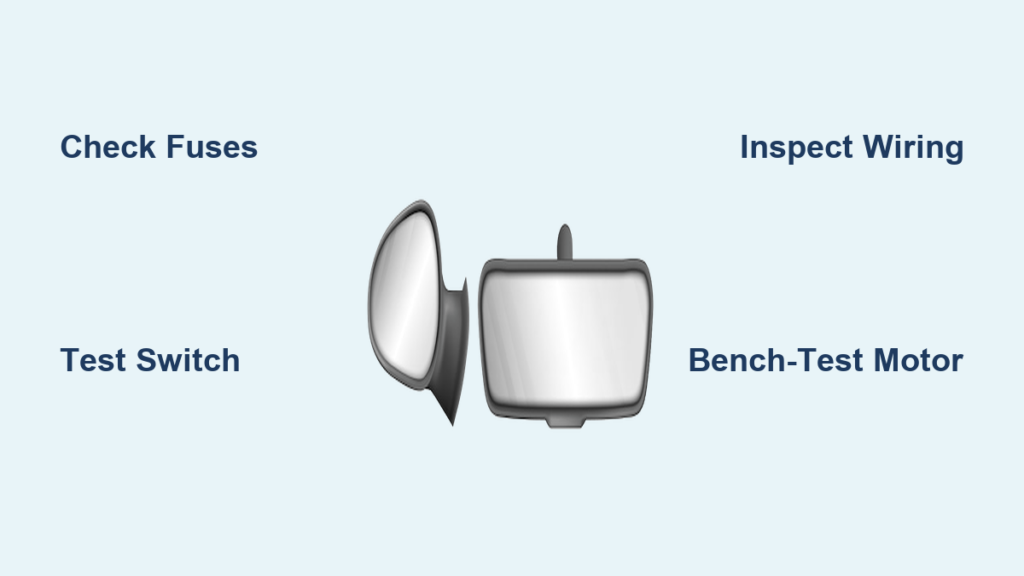
Locate and Test Relevant Fuses
Many vehicles don’t have a dedicated mirror fuse. Instead, power mirrors share circuits with windows, door modules, or the Body Control Module (BCM). Check the interior fuse box under the dash or kick panel. Inspect the engine compartment fuse box if no interior fuse is labeled. Test fuses for windows, door modules, BCM, and interior accessories.
Ford Escape (2017, lower trim): No mirror fuse exists. Both mirrors are controlled through the driver’s window switch. If both mirrors fail, the switch is likely faulty.
Use a fuse tester or multimeter to check for 12V across both terminals. A blown fuse often indicates a short, so replace it only after ruling out wiring issues.
Test Power at the Switch
Loss of power upstream can mimic switch failure. Remove the door panel to access the switch connector. Use a test light or multimeter to check for 12V at the switch’s power input. Clip the test light to chassis ground and probe wires while the ignition is on. If no power reaches the switch, trace back to fuses and relay circuits. If power is present, move to switch output testing.
Diagnose the Mirror Switch
The switch is the most common failure point, especially in high-use vehicles. This component sees constant wear every time someone adjusts their mirror, and the internal contacts degrade over time.
Back-Probe Switch Outputs
The mirror switch routes power to the motor based on direction. Internal contacts wear out over time. With the switch connected, back-probe the wires using paper clips or thin probes. Set selector to driver or passenger side. Press each directional button and test for voltage output.
| Expected Result | Diagnosis |
|---|---|
| Power in, no output | Faulty switch |
| Power in and out | Switch is functional |
| Intermittent output | Worn or oxidized contacts |
2000 Suburban Case: Input power was present, but horizontal (left/right) control failed. Cleaning contacts restored partial function, proving contact wear was the culprit.
Clean or Replace the Switch
For older vehicles, cleaning may extend life. Remove the switch and open the housing. Gently sand contacts with 600+ grit sandpaper. Spray with electrical contact cleaner. Reassemble and test. If cleaning fails or contacts are pitted, replace the switch. Cost ranges from $40 to $100 for OEM or aftermarket parts. This is DIY-friendly with no programming needed on most models.
Ford Escape Tip: Replace the entire window/mirror combo switch if both systems fail, which is common on lower trims.
Test the Mirror Motor Directly

If the switch checks out, the motor may be dead, or it may just need a power boost. Testing the motor directly is the fastest way to confirm whether the problem lies in the motor or somewhere else in the circuit.
Listen for Motor Noise
Activate the switch and press your ear close to the mirror housing. Audible click or hum means the motor is receiving power but may be mechanically bound. No sound on one side suggests a motor or wiring issue on that side. No sound on both sides points to switch, fuse, or power supply problems.
Bench-Test with a 9V Battery
Bypass the car’s wiring and test the motor directly. Disconnect the motor harness. Use a 9V or 12V battery and two wires with alligator clips. Connect to the motor terminals based on polarity.
| Action | Polarity | Result |
|---|---|---|
| Move mirror left | Yellow (+), Blue (–) | Horizontal shift |
| Move mirror right | Blue (+), Yellow (–) | Opposite direction |
| Move mirror up | Green (+), Yellow (–) | Upward tilt |
| Move mirror down | Yellow (+), Green (–) | Downward tilt |
2000 Suburban Result: Applying power to the green wire caused vertical movement, confirming the motor and wiring were functional. The issue was upstream.
If the motor moves with direct power, the issue is upstream (switch, wiring, or connector). If it doesn’t move, replace the motor or mirror assembly.
Inspect Wiring and Connectors

Wiring fatigue in the door hinge area is a top cause of intermittent failure. Every time the door opens and closes, wires flex inside the rubber boot between the door and frame, and this repeated stress eventually takes a toll.
Check the Door Boot Harness
Over time, the constant flexing causes broken copper strands, cracked insulation, and loose or corroded pins. Open the boot carefully. Wiggle the harness while pressing the mirror switch. If the mirror moves during wiggling, a wire is broken somewhere in that section.
Repair Damaged Wires
Cut out the damaged section and strip insulation from both ends. Solder the connection and seal with heat-shrink tubing. Wrap with loom or tape to prevent future chafing. Take photos before disconnecting anything and label connectors to avoid mix-ups during reassembly.
Handle Direction-Specific Failures
If only up/down or left/right works, the problem is isolated to one motor axis. This is a common scenario that often points to a specific component failure.
Diagnose Partial Motor Failure
The mirror motor has dual windings, one for horizontal and one for vertical movement. If one burns out, only two directions will work. The motor may still hum but not move in the failed axis. Fix options include replacing the motor if accessible, replacing the entire mirror assembly (more common), or trying a module reset on modern vehicles.
Kia Telluride (2022): Driver mirror wouldn’t tilt up/down. Memory recall also failed. Pressing the power fold button restored full function, a simple software-level reset.
Reset Integrated Control Modules
Modern vehicles use door modules or BCMs to manage mirrors, and glitches can freeze functions. These systems sometimes enter a fault state after detecting resistance or voltage drops.
Use the Fold/Unfold Trick
If your car has power-folding mirrors, use this quick reset. Press the fold button. Wait 2 seconds. Press unfold. Test mirror adjustment. This often clears temporary faults in the control module and reinitializes communication with the motor position sensor.
Check for Memory and Auto-Tilt Issues
If mirrors don’t recall positions or tilt in reverse, ensure memory seats are programmed. Reprogram memory positions consulting your owner’s manual. Try the fold/unfold reset. No PIDs in your OBD2 scanner is normal. Many systems don’t expose mirror data. If the driver mirror works, the system is enabled, so no programming fix is needed.
Replace Faulty Components When Testing Points to Failure
When testing confirms a failed part, replacement is the final step. Understanding cost and labor helps you decide whether to DIY or visit a shop.
Replace the Mirror Motor
Motors are rarely sold separately. Most come as part of the mirror assembly. Cost ranges from $80 to $200. Labor is moderate and requires removing the mirror glass. DIY is possible with Torx drivers and careful handling. Don’t force the glass. Use a trim tool and follow removal guides to avoid breaking clips or cracking the housing.
Install a Used or Salvage Switch
For older models like the 2000 Suburban, junkyard switches work well and cost 50 to 75% less than new. Ensure the trim and features match (memory, auto-dimming, etc.). Test before full installation to avoid reinstalling a faulty part.
Prevent Future Mirror Failures
Keep your mirrors working longer with simple habits and periodic maintenance. A little prevention goes a long way toward avoiding annoying failures.
Avoid Common Causes of Failure
Moisture causes motor corrosion, so check mirror seals periodically. Don’t hold the switch too long during adjustment, which can overheat windings. Use light pressure when adjusting mirrors and clean contacts every 2 to 3 years. Avoid slamming doors and inspect the door boot every 12 months to catch wiring issues early.
Perform Preventive Resets
If mirror response becomes sluggish or erratic, cycle the power fold/unfold button. Turn the ignition off and on. Reprogram memory positions to ensure the system stays calibrated. These simple resets can prevent minor glitches from becoming major headaches.
Key Takeaways for Fixing a Car Mirror Not Working
A car mirror not working is usually fixable without a mechanic. Start with fuse and switch checks because over 80% of issues originate there. Use the 9V battery test to confirm motor health and rule out the motor as the culprit. Inspect wiring in the door boot for signs of fatigue, chafing, or broken wires. Try the fold/unfold reset on modern vehicles with power-folding mirrors, as this often resolves module-level glitches. With basic tools and this guide, you can restore full mirror function in under an hour and avoid $300+ dealership charges.
Frequently Asked Questions About Car Mirror Not Working
Why won’t my power side mirror move in any direction?
This indicates a complete failure, usually caused by a blown fuse, faulty switch, or no power reaching the motor. Start by checking fuses related to windows and door modules. If fuses are good, test power at the switch and listen for motor noise.
Can I fix a car mirror that only moves in one direction?
Yes. Direction-specific failure usually means one winding in the dual-axis motor has burned out. You can either replace the motor (if available separately) or replace the entire mirror assembly. On some vehicles, a module reset may also fix this.
How do I reset my power folding mirrors?
Press and hold the fold button for 2 seconds, then press the unfold button. Wait a moment, then test normal adjustment. This resets the motor position sensor and clears temporary faults in the control module.
Is the mirror switch the most common failure point?
Yes. The mirror switch sees constant use and the internal contacts wear out over time. Switch failure accounts for the majority of partial and complete mirror control issues. Cleaning may help temporarily, but replacement is usually needed.
Why does my car mirror work sometimes but not others?
Intermittent failure typically points to wiring issues, often in the door boot harness where wires flex repeatedly. Wiggle the harness while pressing the switch to identify broken wires. Corroded connectors or loose pins can also cause this behavior.
Do all vehicles have a dedicated mirror fuse?
No. Many vehicles don’t label a specific mirror fuse. Mirror power is often shared with windows, door modules, or the BCM. Always test fuses related to door electronics even if they aren’t labeled for mirrors.