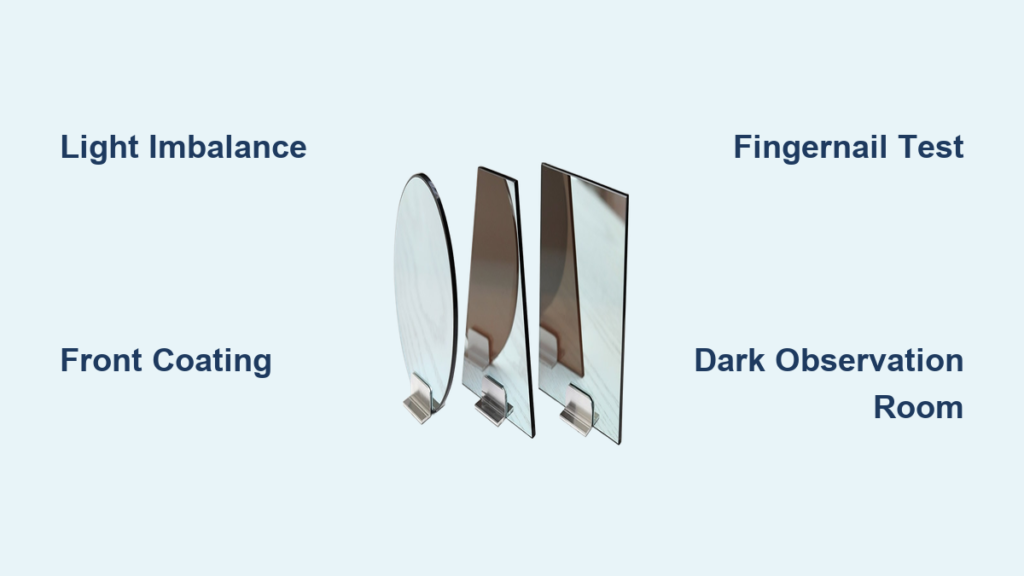
You’ve seen them in crime dramas interrogation rooms where suspects sit unaware, their every move watched from behind a sleek, mirrored wall. But how does a two-way mirror actually work? Despite its name, a two-way mirror isn’t truly one-way. It doesn’t magically allow light to pass in only one direction. Instead, it relies on a clever trick of light imbalance and partial reflectivity to create the illusion of one-way visibility.
At its core, a two-way mirror is a sheet of glass or acrylic coated with an ultra-thin metallic layer, usually aluminum or silver, engineered to reflect about 50% of light while transmitting the other 50% through. This means it’s both a mirror and a window, depending on which side you’re standing. In this guide, you’ll learn the science behind this optical trick, how these mirrors are constructed, and how to detect them in real-world settings.
The Science Behind One-Way Visibility
Why Lighting Imbalance Is Crucial
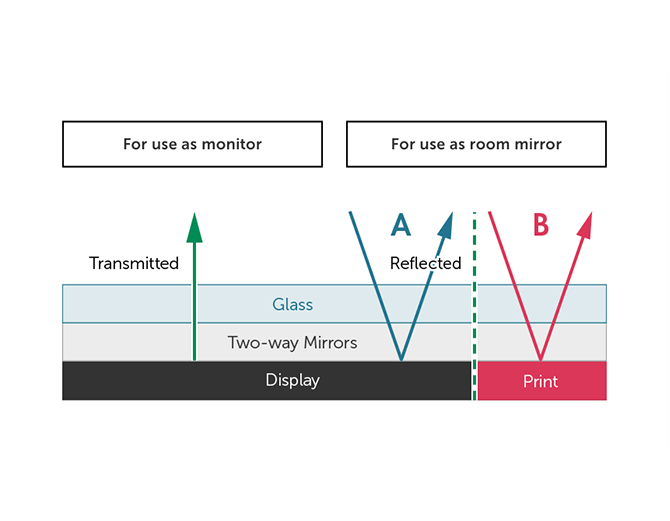
The key to a two-way mirror’s function is unequal lighting. Without it, the one-way illusion collapses completely. When both sides are equally lit, the mirror acts like a tinted window, with partial visibility in both directions. Only when one side is significantly brighter does the mirror effect emerge.
On the bright side, incident light bounces off the semi-reflective surface, creating a strong reflection. Any light coming from the dark side passes through but is too weak to compete visually. The result? People on the bright side see only their reflection.
On the dark side, ambient light is minimal, so reflections are nearly invisible. But the flood of light from the bright side passes through the mirror, allowing clear vision into the lit space. This dynamic isn’t about the mirror itself being directional. It’s about contrast.
Think of it like trying to see stars during the day. The sky is so bright that faint starlight gets drowned out completely. Similarly, the bright room drowns out the dim view from the other side.
How Partial Reflectivity Works
The mirror’s coating is applied using vacuum deposition, a process that sprays a metallic layer just 20 to 50 nanometers thick onto the front surface of the glass or acrylic. This sub-micron layer is thin enough to let light pass through while still reflecting a significant portion.
Because the coating is on the front surface, not the back like in traditional mirrors, there’s no secondary reflection from a glass-air interface. This eliminates the ghosting effect and improves clarity, which is critical for surveillance and optical applications.
Unlike standard mirrors, which are fully opaque due to thick back coatings and protective paint, two-way mirrors are designed to be optically neutral. They’re neither fully reflective nor fully transparent, but balanced between the two.
Construction: How Two-Way Mirrors Are Made
Front-Coated vs. Back-Coated Mirrors
The biggest difference between a two-way mirror and a regular mirror is coating placement. Understanding this distinction clarifies how the optical trick works.
Traditional mirrors have the reflective layer, usually silver or aluminum, applied to the back of the glass. A protective copper and paint layer seals it, making the mirror durable but fully opaque. You can never see through a standard mirror.
Two-way mirrors place the coating on the front surface, so light interacts directly with the metal layer. This allows transmission and prevents double reflections. The absence of that protective backing layer also means two-way mirrors are more delicate and require careful handling.
Two-way mirrors come in glass and acrylic forms, each with distinct advantages.
Glass offers superior clarity, scratch resistance, and longevity. It’s ideal for permanent installations like police stations or laboratories.
Acrylic is lighter, shatter-resistant, and easier to cut. It’s better for temporary setups or displays but more prone to scratching and warping over time.
Tempered versions of both materials are available for high-traffic areas, providing added safety without compromising optical performance.
Mirror Film: A DIY Alternative
For retrofit applications, mirror film can be applied to existing windows. These adhesive films contain a micro-thin metallic layer and mimic the two-way effect under proper lighting conditions.
However, mirror film is less durable than factory-coated glass. It often degrades with UV exposure or moisture. Bubbling, peeling, or hazing can occur over time. Installation quality heavily impacts performance. Air bubbles or uneven application reduce clarity and reflectivity significantly.
Still, mirror film remains a cost-effective solution for homes, offices, or temporary surveillance setups where permanent installation isn’t practical.
Lighting Conditions That Make It Work

Optimal Setup for One-Way Vision
For a two-way mirror to function properly, lighting must be carefully controlled on both sides. The subject side needs to be well-lit with even, diffuse lighting. Avoid spotlights or glare that could reveal transparency.
The observation side must be completely dark or minimally lit. Even a small light leak can compromise the illusion entirely. This is why observation rooms often use blackout curtains, light traps, or double-door entry systems to prevent any light spill.
If the observer room becomes brighter, the transparency reverses. People on the subject side may start seeing into the dark room. This reversal is a common failure mode in poorly installed systems.
Common Lighting Failures to Avoid
Several lighting scenarios can break the one-way effect.
Equal lighting on both sides makes both sides visible. The mirror becomes a semi-transparent barrier, like smoked glass.
A dark subject side makes the mirror appear increasingly transparent, potentially revealing the observation area to anyone paying attention.
Light on the observer side reverses the effect entirely. Surveillance becomes compromised because people on the bright side can now see into what should be the dark room.
To test functionality, turn off lights on the observation side and ensure no internal sources like LEDs or screens emit light that could leak through.
How to Detect a Two-Way Mirror
The Fingernail Test
This simple test takes seconds and requires no special equipment. Press your fingertip directly against the mirror surface.
If there’s no gap between your nail and its reflection, you’re likely looking at a two-way mirror. The coating sits on the surface, so the image isn’t recessed.
If you see a visible gap between your nail and the reflection, it’s a standard mirror. Traditional mirrors have depth between the glass surface and the reflective layer, creating that gap.
The Flashlight Test
This is one of the most reliable detection methods, especially in total darkness. Turn off room lights and shine a bright flashlight, like your phone’s LED, directly at the mirror.
If you see shadows, movement, or a room behind the glass, it’s a two-way mirror. If you just see a bright reflection with nothing behind it, you’re looking at a regular mirror.
The Cupping Method
Cup your hands around your eyes and press close to the mirror. This blocks ambient light and increases contrast. If the other side is brighter, you might see through the glass. This method works because your hands eliminate the reflected light from your side, allowing the transmitted light from the brighter side to dominate.
Tap Test: Why It’s Unreliable
You may have heard that two-way mirrors sound hollower due to lacking protective backing. In reality, sound varies enormously by mounting, frame material, and thickness. This method is not a dependable indicator. Don’t rely on tapping to confirm or rule out a two-way mirror.
Phone-Based Detection
Shine your phone’s bright white screen or flashlight directly onto the mirror in a dark room. Some people report that placing the phone screen flush against the glass enhances visibility through it. While not foolproof, this technique can help reveal whether space exists behind the mirror.
Misconceptions: Do True One-Way Mirrors Exist?
The Thermodynamics Problem
A true one-way mirror that lets light pass in only one direction without external energy would violate the second law of thermodynamics. It could create a temperature imbalance without work, leading to perpetual motion. This sounds alarming, but it’s a misunderstanding.
The mirrors we call two-way are not true one-way devices. They’re passive, partially reflective surfaces whose behavior depends entirely on lighting. They don’t break physics. They use it cleverly.
Real One-Way Optical Devices
True non-reciprocal light control does exist, but not in architectural mirrors. A Faraday isolator uses a magnetic field to rotate light polarization. It allows light to pass forward but blocks reflected light. This device is used in lasers, fiber optics, and optical communication systems.
However, this device requires power and isn’t used in rooms or windows. It proves asymmetric transmission is possible under engineered conditions, but it’s fundamentally different from the lighting-dependent mirrors in everyday use.
Future Technologies
Researchers are developing metamaterials, artificially structured materials that could enable true one-way viewing panels. These could act like light valves, allowing vision in one direction only.
While still experimental and costly, they represent the future of directional optics. They’re far beyond the lighting-dependent mirrors in use today, but the technology is advancing rapidly.
Applications: Where Two-Way Mirrors Are Used
Police Interrogation Rooms
The most famous use. Suspects sit in a brightly lit room, seeing only their reflection. Detectives observe from a darkened room behind the mirror, analyzing behavior without influence.
This setup avoids the Hawthorne effect, where people change behavior when they know they’re being watched. It allows for authentic behavioral analysis.
Reality TV and Film Production
Shows like Big Brother use two-way mirrors to hide cameras and crew. Contestants believe they’re alone while producers monitor constantly from blackout corridors.
This technology is also used for hidden camera shots, secret passages, and invisible set designs throughout the entertainment industry.
Focus Groups and Behavioral Research
Marketers and psychologists use two-way mirrors to observe natural behavior in consumer testing, usability studies, and clinical evaluations. Participants remain unaware, ensuring authentic responses without the observation bias that comes with knowing you’re being watched.
Teleprompters
A teleprompter uses a beam splitter or semi-reflective glass to reflect script text toward the speaker. The camera sees through the glass, capturing the speaker’s face without showing the screen.
This allows presenters to read while maintaining eye contact with the audience, a staple of professional broadcasting.
Infinity Mirrors
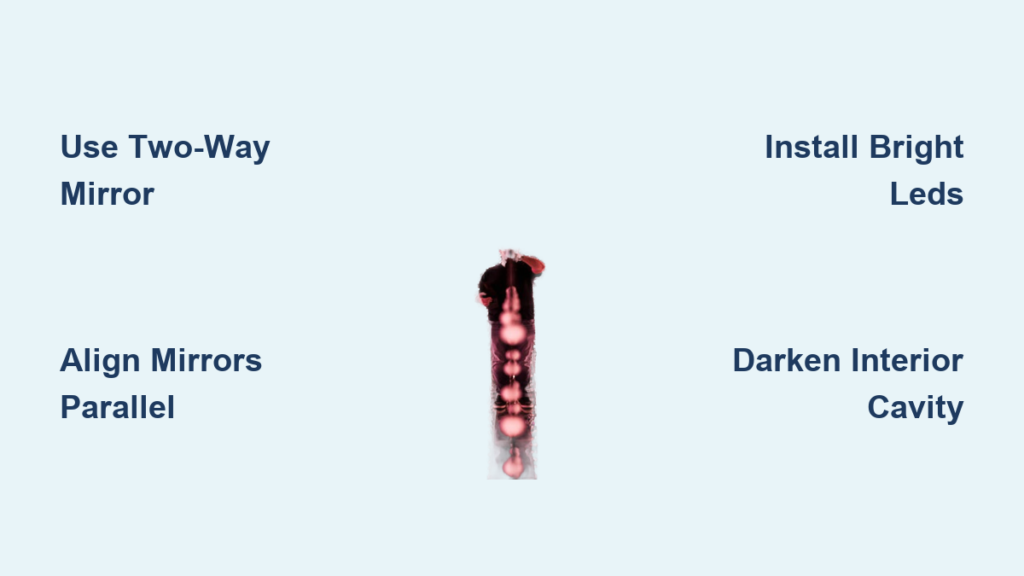
Two parallel two-way mirrors with LEDs between them create an endless reflection tunnel. This effect is used in art installations, home decor, and retail displays to create visually striking environments.
Smart Mirrors and Mirrored TVs
When off, the screen is hidden behind a two-way mirror, appearing as a regular mirror. When on, it displays weather, news, or entertainment.
This technology is popular in smart homes, gyms, and bathrooms where space is limited and dual functionality is desired.
Concealed Security Cameras
Cameras mounted behind two-way mirrors appear as ordinary mirrors from the front. The lens captures video through the transparent side, ideal for retail theft prevention and covert surveillance in businesses.
Installation and Maintenance Tips
Correct Orientation Matters
The coating must face the bright side, which is the subject room. The transparent side faces the dark room, which is the observation area.
Install it backwards and the effect reverses completely. Surveillance fails immediately. Always double-check orientation before final mounting.
Framing and Mounting
Use secure, non-abrasive frames to protect the delicate front coating. Ensure proper ventilation in enclosed spaces to prevent fogging, especially in environments with humidity fluctuations.
Angle the mirror precisely for teleprompters or illusion installations. Even small deviations can ruin the effect.
Cleaning Guidelines
Use soft microfiber cloths and non-ammonia cleaners. Ammonia can degrade the thin metallic coating over time. Avoid abrasive pads or harsh chemicals entirely.
For standard glass or acrylic in low-traffic areas, this care routine is sufficient. For tempered versions in public spaces, inspect regularly for damage and replace if the coating shows signs of wear.
Legal and Ethical Considerations
Using two-way mirrors in private areas like hotel rooms, bathrooms, or changing rooms may violate privacy laws significantly.
In the United States, the Video Voyeurism Prevention Act bans secret surveillance in private spaces. In the European Union, GDPR and national laws require consent and transparency.
Healthcare and research settings often require informed consent when observation is part of the evaluation process. Always consider ethics and legality before installing surveillance mirrors.
If you suspect unauthorized surveillance in a private space, contact local authorities. You have rights, and those rights deserve protection.
Frequently Asked Questions About Two-Way Mirrors
Can a two-way mirror work without a dark room?
No. A two-way mirror requires significant lighting imbalance to function. If both sides are equally lit, it becomes a semi-transparent window with visibility in both directions. The dark room is essential.
How can I tell if a mirror in my hotel room is two-way?
Use the fingernail test. Press your finger against the surface. No gap means it could be a two-way mirror. Then try the flashlight test in complete darkness. If you see through it, it’s not a regular mirror.
Are two-way mirrors safe to use at home?
Yes, when used appropriately. They’re safe for legitimate applications like smart mirrors, privacy windows, or toddler monitoring in daycare settings. Avoid using them in private spaces where occupants haven’t consented to observation.
What’s the difference between a two-way mirror and a one-way mirror?
Nothing. These terms refer to the same device. The one-way label describes the perceived effect, while two-way describes the physical property of allowing light transmission in both directions.
Can two-way mirrors be made privacy-safe at night?
Yes, but it requires careful lighting control. Keep interior lights on while keeping the outside dark, and the effect works. However, any light source on the observation side will compromise privacy.
Key Takeaways on How Two-Way Mirrors Work
A two-way mirror doesn’t work by magic. It works by light balance, using a simple yet brilliant application of optics. The key points to remember are that it uses a thin metallic coating on the front surface, typically 20 to 50 nanometers thick, which reflects about 50% of light while transmitting the other 50%.
The one-way effect depends entirely on lighting imbalance. The bright side sees only reflection while the dark side sees through. Without this contrast, the mirror behaves like tinted glass.
Detection methods like the fingernail test and flashlight test are reliable for identifying covert installations. Always consider legal and ethical implications before using two-way mirrors for surveillance.
From police interrogations to teleprompters, from infinity mirrors to smart homes, this technology blends function and illusion. While true one-way mirrors remain in the realm of advanced physics research, the mirrors we use today prove that sometimes the most powerful tricks are just good physics, well applied.