You look into a mirror every day, but have you ever wondered how it actually works? At first glance, a mirror seems simple—a flat surface that shows your reflection. But behind that clear image is a precise interaction between light and matter governed by physics. The answer to “how does a mirror reflect” lies in specular reflection, a process where light bounces off an ultra-smooth surface in an organized way, preserving the exact pattern of what is in front of it.
Unlike a rough wall that scatters light in all directions, a mirror’s surface is engineered to be smoother than the wavelength of visible light—about 400 to 700 nanometers. This allows it to reflect incoming rays uniformly, following the law of reflection: the angle at which light hits equals the angle at which it bounces off. This predictable behavior creates a coherent, life-like virtual image that appears behind the glass.
In this guide, we will break down the science of mirror reflection step by step, from the physics of light and the role of metal coatings to why your reflection looks flipped and how mirrors are manufactured. Whether you are curious about everyday bathroom mirrors or high-tech telescope optics, you will learn exactly what happens when light meets a reflective surface.
The Law of Reflection: Why Light Bounces at Equal Angles
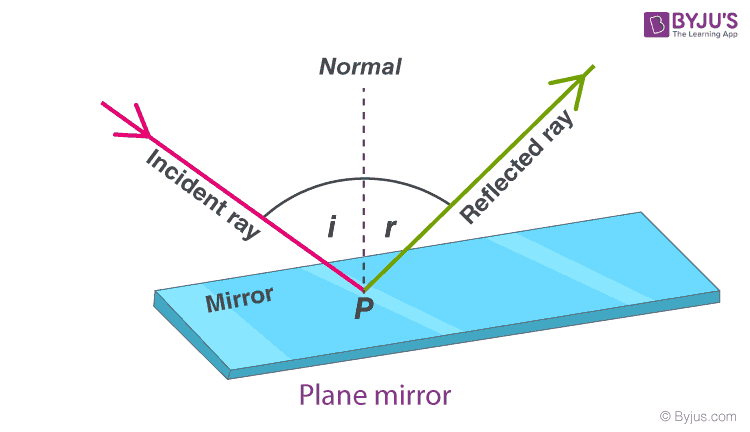
When light strikes a mirror, it does not scatter—it reflects with mathematical precision. This behavior follows the law of reflection: the angle of incidence (incoming light) equals the angle of reflection (outgoing light), both measured from an imaginary line called the normal, which is perpendicular to the mirror’s surface.
Imagine throwing a ball at a wall at a 30-degree angle. It will rebound at the same 30-degree angle. A light ray behaves the same way. Each ray hitting the mirror reflects cleanly, maintaining its spatial relationship with neighboring rays. This coherence is what allows your brain to reconstruct a clear, undistorted image.
Without this law, mirrors could not form recognizable reflections. Any deviation like a warped or rough surface would distort the angles and scramble the image entirely.
Why Smooth Surfaces Matter for Clear Reflections
For the law of reflection to produce a visible image, the surface must be extremely smooth, smoother than the wavelength of visible light. If surface bumps are larger than about 500 nanometers, light rays scatter randomly, resulting in diffuse reflection like you see off paper or walls.
Mirrors avoid this problem by using polished glass coated with metal layers applied at the atomic level. Even microscopic scratches or oxidation can degrade reflectivity over time. That is why high-quality mirrors undergo precision polishing and protective coating to maintain surface integrity.
Specular vs Diffuse Reflection
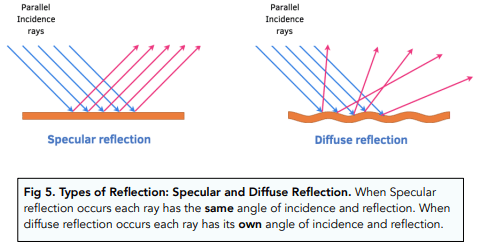
Specular reflection is what makes mirrors work. It occurs on polished, conductive surfaces where light rays reflect in unison, preserving image detail. This is why you see a sharp, recognizable version of yourself in a mirror.
In contrast, diffuse reflection happens on rough materials like wood, fabric, or drywall. Even if these surfaces are bright, they cannot form images because incoming light is scattered in multiple directions due to microscopic surface irregularities.
Snow is a great example. It reflects over 80% of sunlight, yet shows no reflections. Its crystalline texture diffuses light too much for specular behavior.
Surface Roughness Determines Reflection Type
The key difference lies in surface roughness relative to light is wavelength. For visible light, any surface variation greater than about half a micron (500 nm) causes scattering.
Mirrors are polished to one-quarter wavelength or less, often requiring polishing grits of 80,000 to 100,000 to achieve optical smoothness. This level of finish ensures nearly all light reflects coherently, minimizing losses from scattering and maximizing image clarity.
How Light Interacts with Mirror Coatings
Most mirrors use a thin layer of aluminum or silver on the back of glass. These metals are excellent reflectors because they contain free electrons that respond to incoming electromagnetic waves (light).
When light hits the metal, here is what happens:
- The light’s electric field induces oscillations in the free electrons.
- These moving electrons re-emit light at the same frequency and phase.
- The re-emitted wave travels back out, creating the reflection.
This process preserves the wavefront curvature, divergence, and timing of the original light, which is essential for forming accurate virtual images.
Silver reflects 95 to 99% of visible light, while aluminum offers 85 to 90% with better durability. Gold, though poor for visible light, excels in reflecting infrared radiation, which is why spacecraft use gold-coated mirrors to reflect solar heat.
Why Glass Protects the Reflective Layer
The glass front serves multiple roles. It provides structural support, offers optical clarity, and shields the delicate metal coating from scratches and oxidation.
However, light must pass through the glass twice, once going in and once coming out. This can cause slight refraction, chromatic aberration, or ghosting (faint secondary reflections), especially in low-quality mirrors.
Front-Surface vs Back-Surface Mirrors
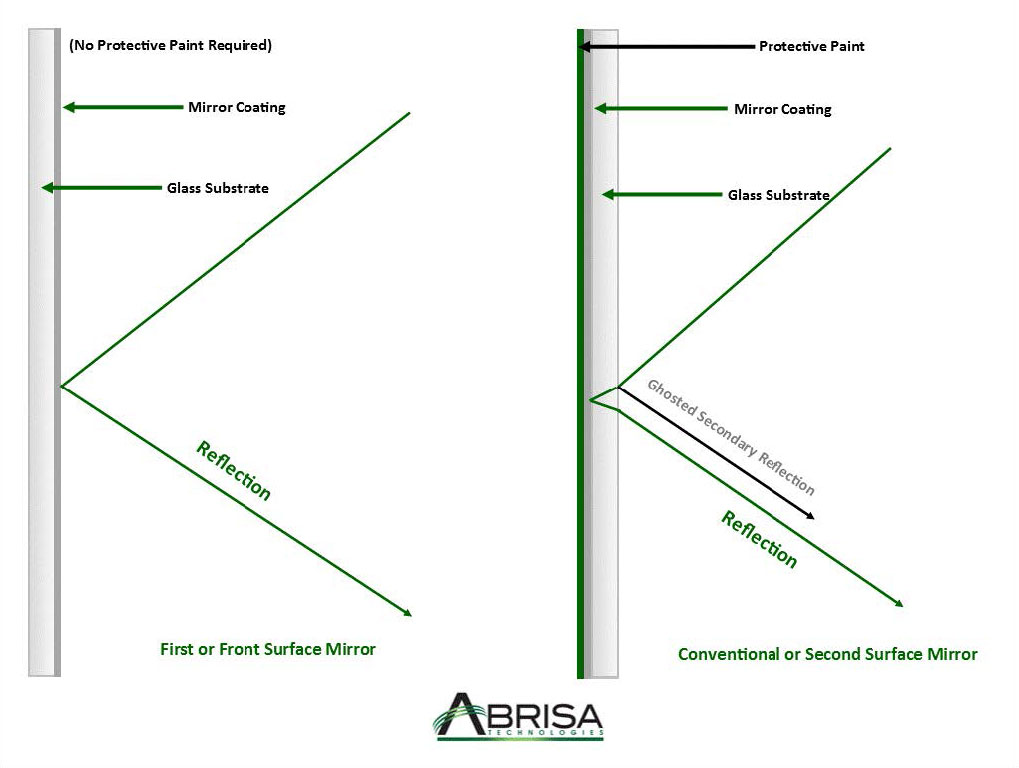
Most household mirrors are back-silvered: the reflective coating is applied to the back of the glass. This design protects the metal but introduces minor distortions due to double-pass refraction through the glass and secondary reflections between front and back surfaces.
These effects are usually negligible for daily use but become problematic in precision optics like telescopes and lasers.
Front-surface mirrors place the reflective layer on the front of the glass. This avoids glass interference entirely, ensuring no chromatic shift, no ghost images, and maximum reflectivity.
To protect the exposed coating, front-surface mirrors often have a transparent dielectric overcoat. While more fragile, they deliver superior optical performance for scientific instruments.
Understanding Virtual Images in Mirrors
A flat mirror forms a virtual image, an optical illusion where light appears to come from behind the mirror. No actual light converges there. The brain interprets the diverging reflected rays as originating from a point behind the glass.
The virtual image has these key properties:
- Same size as the object
- Upright (not inverted)
- Located as far behind the mirror as the object is in front
This is why stepping back from a mirror makes your reflection appear to step back too.
Why Images Appear Reversed Horizontally
Contrary to popular belief, mirrors do not reverse left and right. Instead, they reverse front and back along the axis perpendicular to the surface.
Think of it like turning a glove inside out. It becomes its opposite. Your right hand still appears on the right side of the mirror, but because the image is reversed front-to-back, it looks like a person facing you is raising their left hand.
If you face the mirror sideways, the reversal becomes clearly front-back, not left-right.
Mirror Construction and Materials
Modern mirrors are layered systems. Here is what goes into a typical household mirror:
- Glass substrate (soda-lime glass for clarity and rigidity)
- Reflective coating (aluminum or silver, 0.1 to 0.2 microns thick)
- Protective copper layer (prevents oxidation, especially for silver)
- Paint backing (blocks moisture and physical damage)
Some mirrors use two glass layers with metal sandwiched in between for added safety.
How Reflective Coatings Are Applied
Three main methods apply reflective layers to glass:
- Chemical silvering (1835): Justus von Liebig’s wet process reduced silver nitrate onto glass, enabling mass production of affordable mirrors.
- Vacuum deposition: Metal vaporized in a vacuum condenses evenly on glass. This is used for aluminum telescope mirrors and produces higher quality coatings.
- Sputtering: High-energy ions knock metal atoms onto the surface, producing ultra-durable, pure coatings.
Vacuum methods yield the highest quality and are standard in scientific and aerospace applications.
Types of Mirrors and Their Uses
Plane Mirrors for Everyday Reflection
Flat mirrors produce undistorted, life-sized virtual images. They are used in bathrooms, dressing rooms, and interior design to expand perceived space.
They suffer from lateral inversion (the front-back reversal), but otherwise preserve geometry faithfully.
Concave Mirrors Focus Light
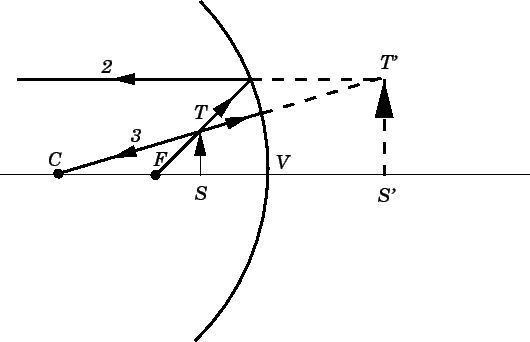
Curved inward, concave mirrors converge parallel light rays to a focal point. Depending on object distance, they can produce real, inverted images (projectable) or magnified virtual images (like makeup mirrors).
These mirrors are used in reflecting telescopes, satellite dishes, and solar furnaces that can reach 3,000 degrees Celsius.
Convex Mirrors Widen the View
Curved outward, convex mirrors diverge light, producing smaller, upright virtual images with a wide field of view.
They are common in rear-view and side-view car mirrors, security mirrors in stores, and blind-corner traffic mirrors. While they sacrifice image size, they enhance situational awareness significantly.
Can Mirrors Reflect Heat and Sound?
Yes, Mirrors Reflect Infrared (Heat)
Heat is infrared radiation, a form of light beyond the visible spectrum. Mirrors can reflect it effectively.
Aluminum and gold are strong infrared reflectors. Spacecraft use gold-coated mirrors to reflect solar heat. Solar concentrators focus infrared to generate power.
Specialized hot mirrors reflect infrared while transmitting visible light, used in projectors and cameras to reduce heat buildup.
No, Mirrors Do Not Reflect Sound Like Light
Sound is mechanical vibration, not electromagnetic waves. A glass mirror may reflect sound due to its solidity, but it is not designed for it.
However, acoustic mirrors, large concrete parabolic structures, were used in World War II to focus sound waves and detect approaching aircraft. These work on the same geometric principle as optical mirrors but for sound instead of light.
Common Mirror Myths Debunked
Mirrors Do Not Reverse Left and Right
False. Mirrors reverse front and back, not left and right. The illusion comes from mentally comparing your reflection to a person who turned around to face you, which would require a physical left-right swap.
Not All Shiny Surfaces Are Mirrors
No. Polished metal or still water may reflect, but only mirrors are engineered for coherent, image-forming reflection. Most shiny objects scatter light too much for clear imaging.
Mirrors Do Not Make Rooms Hotter
Not exactly. Mirrors reflect light but do not amplify energy. They can redirect sunlight, increasing brightness, but only specialized IR-reflective mirrors affect heat significantly.
You Do Not See Yourself in Real Time
Technically, no. Light takes time to travel. At one meter distance, the round-trip delay is 6.7 nanoseconds. You are seeing a version of yourself from the very recent past.
Mirror Applications in Science and Industry
Telescopes and Astronomy
Reflecting telescopes use aluminum-coated primary mirrors to gather faint starlight. The Hubble and James Webb Space Telescopes rely on precision mirrors.
Hubble features a 2.4-meter aluminum-coated glass mirror. James Webb features 18 gold-coated beryllium segments optimized for infrared reflection. These mirrors operate in space to avoid atmospheric distortion.
Lasers and Optical Cavities
Mirrors form the resonant cavity in lasers. One mirror is fully reflective while the other is a partial reflector (output coupler) allowing some light to escape as the laser beam.
Dielectric mirrors ensure minimal loss and maximum efficiency in these systems.
Solar Energy Systems
Parabolic and heliostat mirrors concentrate sunlight to generate steam in solar power plants, melt materials in solar furnaces, and power experiments. Some systems reach temperatures high enough to vaporize steel.
Key Takeaways on How Mirrors Reflect
Mirrors are more than simple glass. They are precision-engineered optical devices that rely on the laws of physics to reflect light with incredible accuracy.
The most important points to remember are:
- Mirrors work through specular reflection, where light bounces off an ultra-smooth surface following the law of reflection (angle of incidence equals angle of reflection).
- The reflective coating (typically aluminum or silver) contains free electrons that re-emit light waves, preserving the original image information.
- What appears to be left-right reversal is actually front-back inversion, a fundamental property of how mirrors create virtual images.
Whether you are checking your appearance or exploring the cosmos, the science of how a mirror reflects is a perfect blend of simplicity and sophistication. The next time you look in a mirror, you will know exactly what is happening at the atomic level to create that clear reflection.
Frequently Asked Questions About Mirror Reflection
Why do mirrors reflect light?
Mirrors reflect light because their metal coatings contain free electrons that oscillate when light hits them. These oscillations re-emit the light wave at the same frequency and phase, sending it back in a predictable direction according to the law of reflection.
What is the difference between specular and diffuse reflection?
Specular reflection occurs on smooth surfaces like mirrors, where light rays reflect in unison and preserve image detail. Diffuse reflection happens on rough surfaces like paper, where light scatters in multiple directions and no image forms.
Can mirrors reflect 100% of light?
No mirror reflects 100% of light. Standard household mirrors reflect 85 to 90% of visible light. The rest is absorbed by the glass and metal coating or lost due to surface imperfections. Specialized dielectric mirrors can exceed 99% reflectivity but only for narrow wavelength bands.
Why does my reflection look reversed in a mirror?
Mirrors do not actually reverse left and right. They reverse front and back along the axis perpendicular to the mirror surface. Your brain interprets the reflection as if someone turned around to face you, which creates the illusion of left-right reversal.
Do mirrors reflect ultraviolet or infrared light?
Standard mirrors reflect visible light best. Specialized coatings are required for efficient reflection of ultraviolet or infrared radiation. Gold-coated mirrors excel at reflecting infrared, while aluminum works well for both UV and visible light.
How do concave and convex mirrors differ?
Concave mirrors curve inward and converge light, producing magnified images or focusing light to a point. Convex mirrors curve outward and diverge light, producing smaller images with a wider field of view.