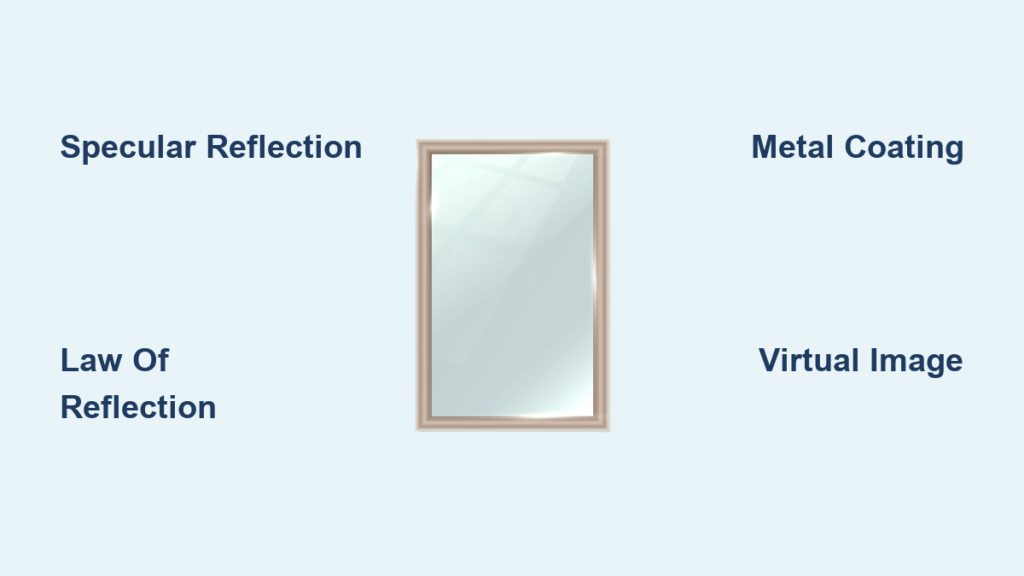
Have you ever wondered why your reflection stares back at you with perfect clarity when you look into a mirror? The answer lies in the precise physics of light and surface interaction. Mirror reflections work because light bounces off an extremely smooth, metallic-coated surface following the law of reflection—angle of incidence equals angle of reflection—creating a virtual image that appears behind the glass. This phenomenon isn’t magic; it is science in action.
When light from your face travels to the mirror, it reflects off the surface and re-enters your eyes. Your brain interprets these rays as if they came from behind the mirror, forming a lifelike, upright image. Unlike rough surfaces that scatter light like paper or walls, mirrors preserve the direction and coherence of incoming light, allowing us to see sharp, undistorted reflections. From bathroom mirrors to space telescopes, this principle enables everything from daily grooming to exploring distant galaxies.
In this guide, we will break down exactly how mirror reflections work step by step, covering the physics of light, the structure of mirrors, why images appear reversed, and how different mirror types alter reflection behavior. You will also learn common misconceptions, real-world applications, and what makes a mirror truly reflective.
Light Behavior and the Law of Reflection
Mirror reflections begin with light, a form of electromagnetic radiation that travels in straight lines until it interacts with matter. To understand how mirrors reflect so clearly, we must examine how light behaves at surfaces.
How Light Interacts With Surfaces
When light hits any surface, three things can happen. The material can absorb the light, soaking it up like black fabric does. The light can transmit through the material, as it does through clear glass. Or the light can reflect, bouncing back toward the source. Mirrors are engineered to maximize reflection. They use a highly conductive metallic coating, typically silver or aluminum, that repels incoming light waves instead of absorbing them. Because the surface is atomically smooth, light reflects uniformly rather than scattering in random directions.
This type of clean, organized bounce is called specular reflection, and it distinguishes mirrors from everyday objects. Most things around you, walls and clothes and books, reflect light too, but diffusely. Their microscopic roughness scatters light in all directions, making them visible but not reflective.
The Law of Reflection Explained
All mirror reflections obey one fundamental rule. The angle of incidence equals the angle of reflection. The angle of incidence measures the angle between the incoming light ray and the normal, an imaginary line perpendicular to the mirror at the point of contact. The angle of reflection measures the angle between the reflected ray and the same normal. Both rays lie in the same plane, ensuring predictable, symmetrical reflection.
Think of it like a tennis ball hitting a wall. If it strikes head-on, it rebounds straight back. If it hits at 30 degrees, it bounces off at 30 degrees on the opposite side. This geometric precision allows mirrors to preserve the spatial relationships of objects. Every detail, from the curl of your hair to the shape of a distant tree, is accurately mapped in the reflection because each point sends light to the mirror at a unique angle, which then reflects to your eye.
Specular vs. Diffuse Reflection
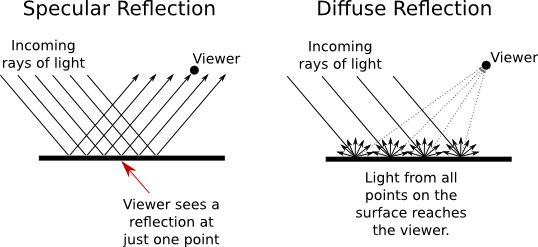
Not all reflections are mirror-like. Whether you see a sharp image or just a glow depends entirely on surface texture.
What Makes a Surface Mirror-Like
A surface produces specular reflection only when it is smoother than the wavelength of visible light, which ranges from about 400 to 700 nanometers. If surface bumps are smaller than this, light rays maintain their relative alignment after bouncing, forming a coherent image. That is why polished metals, still water, and glass mirrors reflect so well. Their surfaces are engineered to be nearly atomically flat. Even a fingerprint can disrupt this smoothness, causing slight blurring.
In contrast, diffuse reflection occurs on rough surfaces like drywall, fabric, or paper. Microscopic peaks and valleys scatter light in random directions. While this makes objects visible from many angles, no clear image forms. Snow reflects nearly all visible light, which is why it looks white, but its crystalline structure is too irregular for specular reflection. Each ice crystal redirects light unpredictably, resulting in a bright but non-reflective surface.
Some materials like glossy paint or polished stone fall in between. They may appear shiny but still produce hazy, semi-diffuse images due to micro-roughness. Only truly smooth, conductive surfaces yield perfect mirror reflections.
Mirror Construction: How Mirrors Are Made
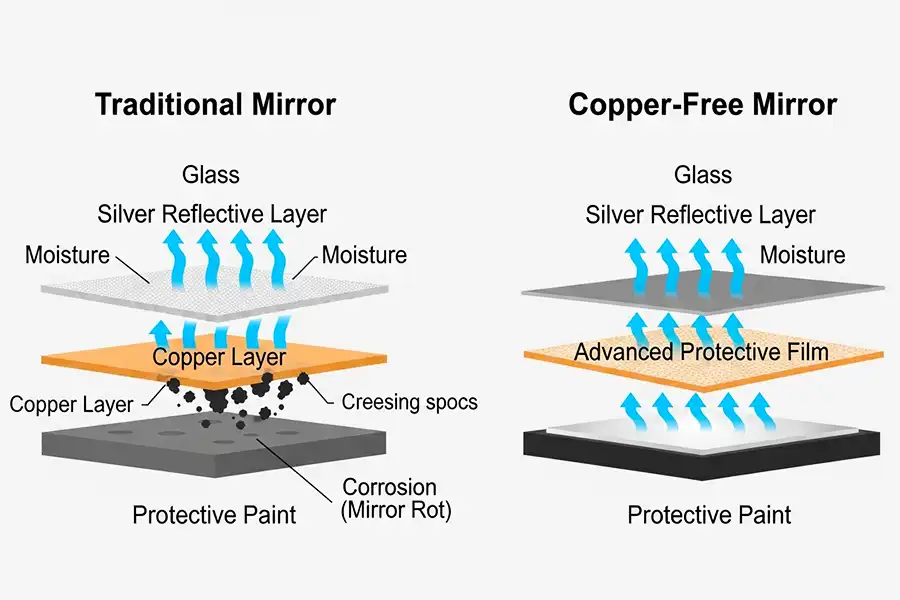
Behind every reflection is a carefully engineered structure. A typical mirror is not just glass. It is a layered system designed to reflect light efficiently and durably.
Components of a Modern Mirror
Every standard mirror consists of two key parts. The glass substrate provides rigidity, transparency, and protection. The metallic reflective coating, applied to the back or front, does the actual reflecting work. The glass itself does not do the reflecting. It is the thin metal film beneath that does the work. Without it, glass reflects only about 4 percent of incoming light from its front surface, which is why windows sometimes show faint reflections.
Common Reflective Coatings
Different metals offer varying levels of reflectivity, durability, and spectral response. Silver reflects 95 to 99 percent of visible light and is used for high-quality mirrors and optics. Aluminum reflects 85 to 90 percent and is common in telescopes and household mirrors. Gold reflects poorly in visible light but highly in infrared, making it ideal for infrared systems and spacecraft. Chrome reflects about 60 to 70 percent and is used for automotive mirrors and industrial applications. Silver offers the highest reflectivity across the visible spectrum, which is why premium mirrors use it. However, silver tarnishes easily when exposed to air, so it is protected with copper and paint layers.
Aluminum is more durable and widely used in scientific instruments. It is often applied via vacuum deposition for uniform thickness and long-term stability.
Manufacturing Process: From Glass to Mirror
Modern mirrors are made using precise industrial techniques. First, raw glass is cut to size and meticulously cleaned to remove contaminants. Then coating application occurs. Wet silvering, developed in 1835 by Justus von Liebig, involves spraying a solution of silver nitrate onto glass, where it chemically reduces to form a thin metallic layer. Vacuum deposition is used for aluminum and other metals. In a vacuum chamber, metal is heated until it vaporizes and condenses evenly on the glass surface. Sputtering uses ions to bombard a metal target, ejecting atoms that deposit onto the glass. This produces extremely uniform, durable coatings. Finally, a protective backing is added. For silver mirrors, a copper layer is added, followed by paint. Aluminum mirrors may be coated with silicon dioxide or other dielectrics for protection.
Front-Surface vs. Back-Surface Mirrors
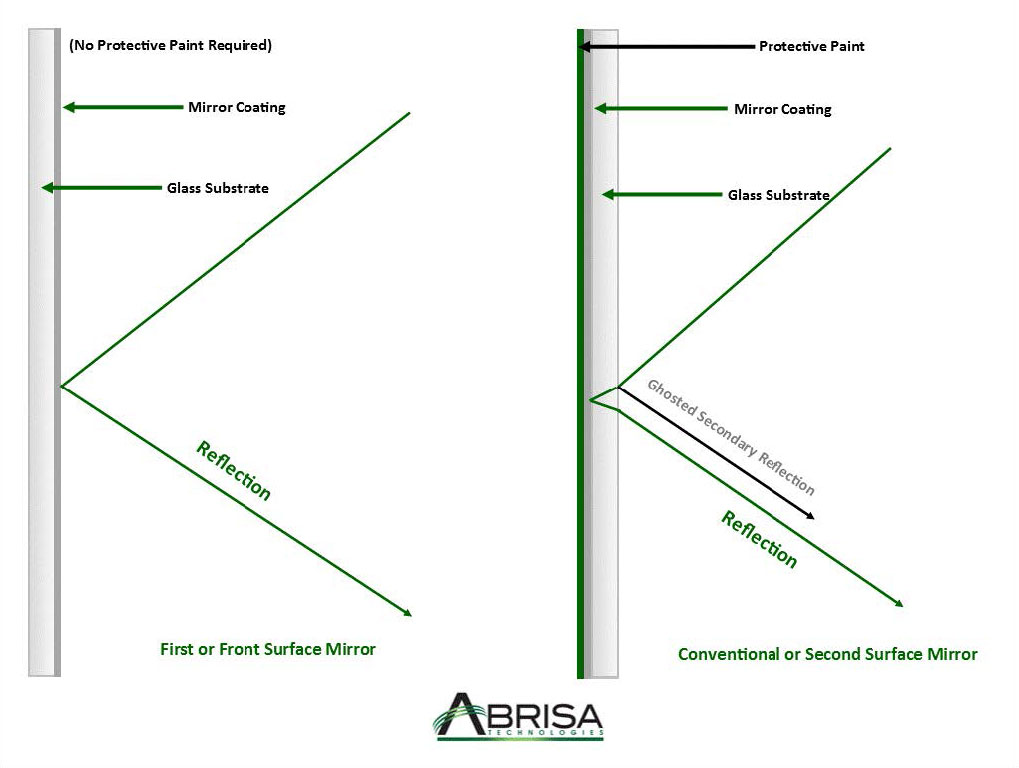
Not all mirrors are built the same. The placement of the reflective coating determines performance and application.
Back-Silvered Mirrors
In most bathroom and wall mirrors, the reflective coating is on the back of the glass. This design protects the delicate metal layer from scratches and oxidation. However, it introduces a minor optical flaw called double reflection. Light first reflects off the front surface of the glass, about 4 percent, then again off the metallic coating. This can cause faint ghosting or reduced contrast, especially in bright lighting. Despite this, back-silvered mirrors dominate consumer markets due to their durability and low cost.
Front-Surface Mirrors
In scientific and optical systems like telescopes, lasers, and interferometers, the reflective coating is applied to the front of the glass. This eliminates double reflection and preserves wavefront accuracy, making images sharper and more precise. However, the exposed coating is vulnerable to damage, dust, and oxidation. These mirrors require careful handling and are often housed in sealed enclosures. Some advanced versions include a transparent dielectric overcoat that protects the metal while maintaining optical clarity, ideal for high-end imaging systems.
Virtual Images: Why Reflections Appear Behind the Mirror
When you look into a flat mirror, your image seems to exist behind the glass. But no light actually passes through that space. What you are seeing is a virtual image, an optical illusion created by your brain.
How Virtual Images Form
Light rays from your face travel to the mirror and reflect according to the law of reflection. When these reflected rays enter your eye, your brain assumes they traveled in straight lines. It traces them backward to a point behind the mirror, where they appear to originate. Since no real light converges there, the image cannot be projected onto a screen, unlike real images formed by lenses or concave mirrors. But it feels real because it preserves size, distance, color, contrast, and depth perception for binocular observers.
Properties of Plane Mirror Images
Plane mirror images are upright, not inverted vertically. They appear laterally inverted, seeming to flip left to right. The image appears the same distance behind the mirror as the object is in front. The image cannot be captured on a screen. These traits make flat mirrors ideal for personal grooming, optical alignment, and periscopes.
The Truth About Left-Right Reversal
One of the most persistent myths about mirrors is that they reverse left and right. In reality, mirrors reverse front and back, not left and right.
Why It Feels Like a Swap
When you raise your right hand, your reflection raises the hand on the right side of the image. But because the reflection faces you, it looks like a person facing you raised their left hand. The confusion comes from mental rotation. To imagine someone standing where your reflection appears, you would have to turn around, rotating 180 degrees, which swaps left and right. The mirror does not do this. Your mind does.
Demonstration With Transparent Paper
Write on a transparent sheet and hold it up to a mirror. It reads normally. But if you write on opaque paper, you must turn it around to face the mirror, which flips the text. Again, the reversal happens due to your action, not the mirror. If you were to flip yourself upside down to face the mirror, your reflection would appear inverted top to bottom, proving the mirror simply reverses along the axis perpendicular to its surface, the z-axis.
This phenomenon is known in physics as chirality. An object and its mirror image are non-superimposable, like left and right gloves. The mirror creates an inside-out version of you, not a rotated one.
Optical Quality: What Makes a Good Mirror
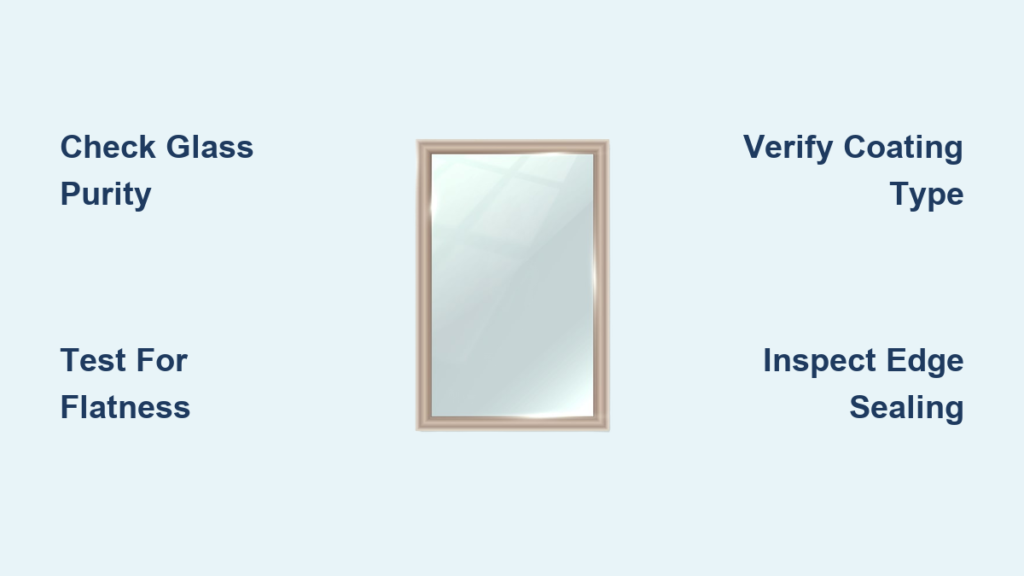
Not all mirrors are equal. Performance depends on three key factors: reflectivity, surface flatness, and smoothness.
Reflectivity Ratings
Dielectric mirrors can reflect more than 99.9 percent of light but only within narrow wavelength ranges. Enhanced silver reflects up to 99.9 percent. Standard silver reflects 95 to 99 percent. Aluminum reflects 85 to 90 percent. Chrome reflects about 60 percent. First-surface mirrors generally reflect more light because they eliminate losses from front-glass reflection and absorption.
Surface Flatness Standards
Deviations from perfect flatness distort images. Household mirrors made from float glass have deviations of about 5600 to 8800 nanometers per inch. Telescope mirrors are much tighter, as tight as 12 nanometers across the entire surface. Even tiny warps can blur laser beams or astronomical images.
Surface Roughness Requirements
To avoid diffuse reflection, surface roughness must be less than 100 nanometers, smaller than visible light wavelengths. Optical-grade mirrors achieve 200 to 100 nanometers roughness, measured in fractions of a wavelength or grit size up to 100,000. Interestingly, longer wavelengths like microwaves can reflect off wire mesh, while X-rays require grazing incidence angles nearly parallel to the surface due to their extremely short wavelengths.
Types of Mirrors and Their Uses
Mirrors come in various shapes, each altering how light reflects and images form.
Plane Mirrors
Flat mirrors produce upright, life-sized, laterally inverted virtual images. They are common in bathrooms, dressing rooms, and optical instruments like periscopes and alignment tools. They do not magnify or distort, making them ideal for accurate self-inspection.
Concave Mirrors
Curved inward, these mirrors converge light rays to a focal point. When an object is beyond the focal point, they produce an inverted real image, used in telescopes. When an object is within the focal point, they produce an upright magnified virtual image, used in makeup and shaving mirrors. Applications include headlights, solar furnaces, and astronomical telescopes like Hubble and James Webb.
Convex Mirrors
Curved outward, these mirrors diverge light, creating smaller, upright virtual images. They offer a wider field of view and are safer for monitoring large areas. They are used in car side-view mirrors, security mirrors in stores and parking lots, and surveillance systems.
Specialized Mirror Shapes
Parabolic mirrors focus parallel rays to a single point, used in radio telescopes, satellite dishes, and solar concentrators. Cylindrical mirrors focus light into a line, ideal for heating fluids in solar thermal systems. Segmented mirrors are made of many small mirrors aligned together, used in giant telescopes like Keck Observatory where a single mirror would be too large.
Energy and Color in Reflection
Mirrors do not create or destroy light. They redistribute it according to the law of conservation of energy.
Where Does the Light Go
When light hits a mirror, most reflects, typically 90 to 99 percent depending on the coating. Some absorbs, converting to heat, about 5 to 10 percent in aluminum. Transmission is minimal in standard mirrors. A silver mirror reflects about 95 percent of visible light, absorbing only 5 percent. That is why mirrors feel slightly warm after prolonged exposure to sunlight.
Do Mirrors Change Color
No. Unlike colored objects that absorb certain wavelengths, mirrors reflect the entire visible spectrum equally. A red apple looks red in the mirror because it reflects red light, and the mirror faithfully preserves that. Even people with color vision deficiencies see accurate reflections. The mirror does not alter the light entering their eyes. The perception may differ, but the reflection itself is true to life.
Real-World Reflection Phenomena
Mirror physics explains everyday observations from seeing around corners to the speed of reflections.
Seeing Around Corners
You can see someone standing to the side of a mirror because light from them strikes the mirror at an angle and reflects into your eyes. This is like playing pool. Aim a ball at a rail, and it bounces off predictably. Light behaves the same way. This principle enables periscopes used in submarines, surveillance systems, and optical communication relays.
No Delay in Reflection
Light travels at 300,000 kilometers per second. For someone standing 1 meter from a mirror, the total path is 2 meters, and the time delay is about 6.7 nanoseconds. This is far below human perception, so reflections appear instantaneous.
Applications of Mirrors in Science and Life
Mirrors are everywhere, from your bathroom to the edge of the universe.
Daily and Decorative Uses
Mirrors are essential for personal grooming, interior design to create illusion of space, and art and fashion displays.
Safety and Functional Tools
Mirrors serve critical roles in rear-view and side mirrors in vehicles, dentist mouth mirrors, security convex mirrors in hallways, and emergency signaling using reflective surfaces.
Scientific and Advanced Technologies
Telescopes use large concave mirrors to collect faint starlight. The James Webb Space Telescope uses gold-coated beryllium mirrors. Lasers use mirrors to contain and direct coherent beams. Cameras use mirrors in SLR viewfinders to show real-time images. Medical devices like endoscopes use tiny mirrors for internal imaging. Atomic mirrors reflect matter waves in quantum experiments.
Special Mirror Types
Acoustic mirrors reflect sound, used in WWII aircraft detection and modern parabolic microphones. Infrared mirrors reflect heat, used in thermal imaging and spacecraft insulation. Phase-conjugating mirrors reverse light waves to correct distortions in imaging. X-ray mirrors use grazing incidence to reflect high-energy photons in space telescopes.
Historical Evolution of Mirrors
Mirror technology has evolved over millennia from water pools to space-grade optics.
Ancient Beginnings
Prehistoric people used still water and polished obsidian. The earliest known mirrors date to around 6000 BCE in Anatolia. Bronze Age civilizations used polished copper, bronze, and speculum metal mirrors. China around 2000 BCE produced bronze mirrors with intricate designs. These early mirrors were dim and distorted, likely inspiring the biblical phrase see in a mirror, darkly.
Glass Mirror Revolution
In the first century CE, early glass mirrors with lead or gold backing appeared. In sixteenth century Venice, master glassmakers produced flat sheets using cylinder-unrolling techniques and tin-mercury amalgam coatings. Mirrors were luxury items. One noble traded a farm for a single mirror.
Industrial Age Breakthroughs
In 1835, Justus von Liebig invented chemical silvering, making mirrors affordable. In the 1930s, John D. Strong pioneered vacuum aluminum deposition for telescopes. The twentieth century brought sputtering and dielectric coatings that enabled high-performance optics. These advances democratized mirrors and enabled modern science.
Safety and Modern Mirror Design
Today’s mirrors prioritize safety without sacrificing clarity.
Shatter-Resistant Features
Tempered glass is heat-treated to break into small, dull pieces. Protective films are thin layers that hold shards together. Plastic mirrors use aluminum-coated polymer films, used in gyms, kids rooms, and vehicles. These designs reduce injury risk in high-traffic or impact-prone areas while maintaining optical quality.
Frequently Asked Questions About Mirror Reflections
Why do mirrors reverse left and right but not up and down
Mirrors do not actually reverse left and right. They reverse front and back along the axis perpendicular to the mirror surface. The perception of left-right reversal occurs because we mentally compare our reflection to another person facing us, which requires rotation, not reflection.
Can mirrors reflect all types of light
Mirrors reflect most visible light efficiently, but reflectivity varies by wavelength and coating material. Silver reflects visible light best. Aluminum handles ultraviolet well. Gold excels at infrared. X-rays require special grazing-incidence mirrors.
Why do some mirrors give blurry reflections
Blurry reflections result from surface imperfections. Fingerprints, dust, scratches, or manufacturing defects disrupt the smooth surface needed for specular reflection. Even micro-roughness above 100 nanometers can scatter light and reduce clarity.
Do mirrors lose reflectivity over time
Yes. Silver mirrors can tarnish when exposed to air, reducing reflectivity. Aluminum resists tarnishing better. Both can accumulate scratches and contamination. Protected coatings and proper cleaning help maintain reflectivity.
How do curved mirrors create different image types
Concave mirrors converge light and can produce magnified virtual images when the object is close, or inverted real images when the object is far. Convex mirrors diverge light and always produce smaller, upright virtual images with a wider field of view.
Why do mirrors appear to reverse colors in certain lighting
Mirrors do not reverse colors. They reflect all wavelengths equally. Color changes you notice result from lighting conditions, the object’s own color reflection, or your perception under different light sources. The mirror itself remains color-neutral.
Key Takeaways for Understanding Mirror Reflections
Mirror reflections work because of the law of reflection, where light bounces off an ultra-smooth metallic surface at equal angles. The key to a good mirror is surface smoothness smaller than the wavelength of visible light, typically less than 100 nanometers. This smoothness enables specular reflection, preserving the direction and coherence of light to form clear images.
Virtual images form behind the mirror because your brain traces reflected light rays backward, creating the illusion of depth. The image is the same size and distance as the object, but laterally inverted due to perceptual interpretation, not the mirror flipping left and right.
From household bathroom mirrors to the James Webb Space Telescope, the same fundamental physics of reflection applies. Understanding how mirror reflections work reveals the elegant science behind everyday objects and humanity’s most advanced optical technologies.