
A single miscalculation in glass weight can crack a budget, buckle a support beam, or send a panel crashing to the floor. Whether you’re sizing a shower door, planning a curtain wall delivery, or engineering a glass railing, the numbers matter. The good news is that glass weight calculation follows a simple physics rule: Weight = Density × Volume. This guide breaks down the formulas, density values, and real-world examples you need to get it right every time.
You’ll learn how to pick the correct density for your glass type, apply metric and imperial formulas, handle complex shapes and insulated units, and avoid the calculation errors that cause the most headaches on the job.
Select the Correct Glass Density for Your Material

Match the Glass Type to the Right Density Value
Density is the variable that changes everything. Standard float glass sits at 2,500 kg/m³, but specialty glasses range from 2,200 to 3,700 kg/m³. Choosing the wrong value skews your entire result, so start by identifying what you’re working with.
| Glass Type | Density (kg/m³) | Typical Use |
|---|---|---|
| Annealed/Float Glass | 2,500 | Standard windows, storefronts |
| Tempered Glass | 2,520 | Shower doors, railings |
| Laminated Glass | 2,480 | Windshields, security glass |
| Low-Iron Glass | 2,510 | High-clarity displays |
| Borosilicate (Pyrex) | 2,230 | Labware, oven doors |
| Wired Glass | 2,570 | Fire-rated applications |
| Lead Crystal | 2,960 | Decorative items |
Pro Tip: For most architectural projects, use 2,500 kg/m³ as your default unless you’re working with specialty glass.
Understand Why Density Varies
The tempering process strengthens glass but does not change its density. A tempered panel weighs the same as an annealed panel of identical dimensions. Laminated glass, on the other hand, is slightly lighter because the PVB interlayer is less dense than glass itself. Using 2,500 kg/m³ for laminated glass will overestimate the weight by about 0.8%, which is fine for rough estimates but not for precision engineering.
Apply the Metric Formula for Fast, Accurate Results
Use the Standard Engineering Formula
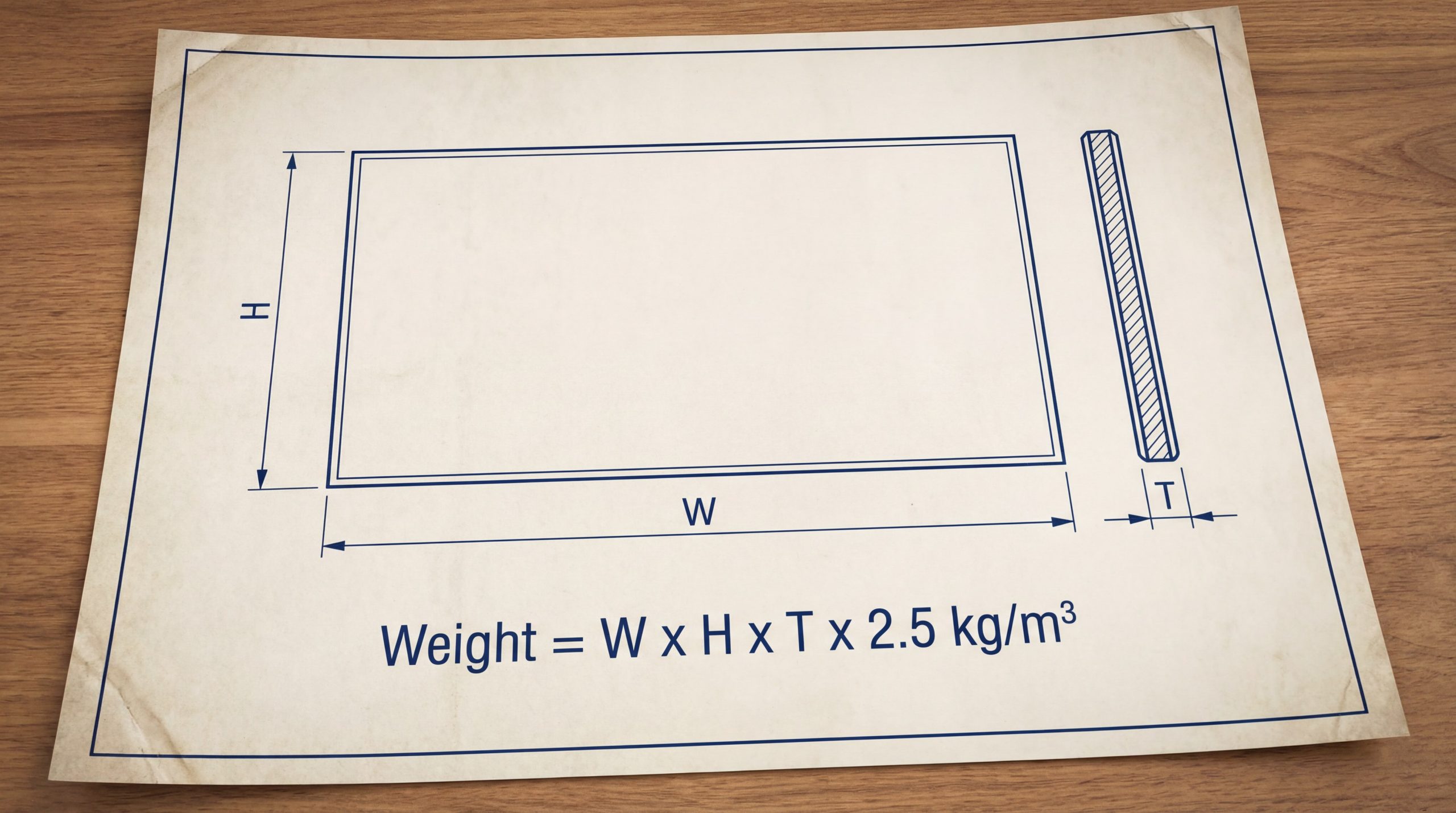
The metric system makes glass weight calculation straightforward. The most practical formula for architectural panels is:
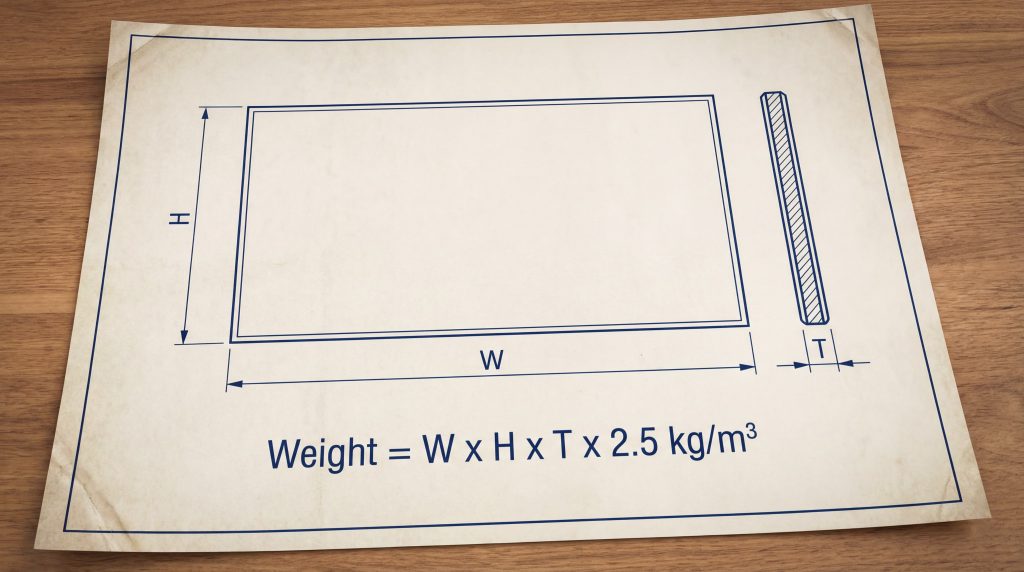
Weight (kg) = Length (m) × Width (m) × Thickness (mm) × 2.5
This works because 1 m² of 1 mm thick glass at 2,500 kg/m³ density weighs exactly 2.5 kg.
Example: 1200 mm × 1800 mm × 8 mm Tempered Glass
- Convert to meters: 1.2 m × 1.8 m
- Apply formula: 1.2 × 1.8 × 8 × 2.5 = 43.2 kg
Reference Common Thicknesses at a Glance
Memorize this quick-reference table for field estimates:
| Thickness (mm) | Weight per m² (kg) |
|---|---|
| 4 mm | 10.0 kg |
| 6 mm | 15.0 kg |
| 8 mm | 20.0 kg |
| 10 mm | 25.0 kg |
| 12 mm | 30.0 kg |
| 19 mm | 47.5 kg |
| 25 mm | 62.5 kg |
Quick Tip: For standard float glass, multiply thickness in mm by 2.5 to get kg per m² instantly.
Use the Imperial Formula for U.S. Projects
Calculate Weight in Pounds
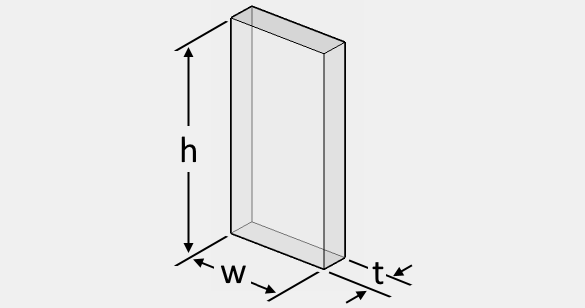
In the United States, dimensions often come in feet and inches. The go-to formula is:
Weight (lbs) = Length (ft) × Width (ft) × Thickness (in) × 0.077
The 0.077 factor represents the weight of float glass in pounds per square foot per inch of thickness.
Example: 3 ft × 5 ft × 1/4 in Annealed Glass
- Area: 3 × 5 = 15 sq ft
- Thickness: 0.25 in
- Weight: 15 × 0.25 × 0.077 = 28.88 lbs
Adjust the Constant for Different Glass Types
Don’t use 0.077 for every glass type. Adjust based on what you’re installing:
- Float Glass: × 0.077
- Tempered Glass: × 0.080
- Laminated Glass: × 0.085
- Bronze/Reflective: × 0.078
Reference Imperial Weight per Square Foot
For quick field estimates, keep these values handy:
| Thickness | Weight per ft² (lbs) |
|---|---|
| 1/8 in | 1.64 lbs |
| 1/4 in | 3.27 lbs |
| 3/8 in | 4.90 lbs |
| 1/2 in | 6.54 lbs |
| 3/4 in | 9.81 lbs |
| 1 in | 13.08 lbs |
Example: A 4 ft × 8 ft (32 sq ft) panel of 1/2″ glass weighs 32 × 6.54 = 209.3 lbs.
Calculate Weight for Non-Rectangular Shapes
Find the Area First, Then Apply Thickness
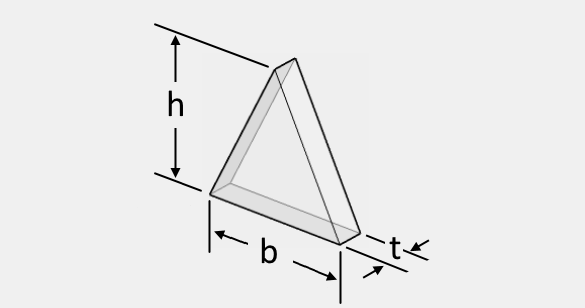
For circles, triangles, or irregular panels, calculate the area using geometry, then multiply by thickness and density.
Circular Glass Table: 1000 mm Diameter × 12 mm
- Radius = 500 mm = 0.5 m
- Area = π × r² = 3.1416 × 0.5² = 0.7854 m²
- Weight = 0.7854 × 12 × 2.5 = 23.6 kg
Triangular Glass Panel: 900 mm × 1200 mm × 10 mm
- Area = 0.5 × base × height = 0.5 × 0.9 × 1.2 = 0.54 m²
- Weight = 0.54 × 10 × 2.5 = 13.5 kg
Break Complex Shapes into Simple Sections
For irregular shapes, split the panel into rectangles and triangles, calculate each section separately, then sum the areas before applying the thickness factor.
Pro Tip: Add a 10–15% buffer for cutting waste and handling when ordering or transporting irregular panels.
Handle Insulated and Laminated Glass Units
Calculate IGUs by Summing Each Pane
Double or triple glazing adds weight from multiple layers, but the gas fill and spacers contribute less than 1% and can be ignored.
Rule: Add the weight of each glass layer.
Example: Double Glazed Unit with Two 6 mm Panes
- Each pane: 15 kg/m²
- Total: 15 × 2 = 30 kg/m²
- For a 2 m × 1.5 m panel (3 m²): 3 × 30 = 90 kg
Account for the Lighter PVB Interlayer
Laminated glass includes a PVB or SGP interlayer that is less dense than glass. Use 2,480 kg/m³ (or 2.48 in the metric formula) and an imperial constant of 0.085 instead of 0.077.
Example: 2000 mm × 3000 mm Laminated Panel (2×6 mm + PVB)
- Area: 6 m²
- Effective thickness: 12.76 mm
- Weight = 6 × 12.76 × 2.48 = 189.8 kg
Note: For exact bespoke laminates with non-standard interlayers, consult manufacturer specifications.
Check Real-World Panel Weights Before You Commit

Common Applications and Their Weights
| Application | Dimensions | Thickness | Weight |
|---|---|---|---|
| Residential Window | 36″ × 48″ | 1/4″ | 39 lbs (17.7 kg) |
| Storefront Panel | 36″ × 96″ | 1/4″ | 78 lbs (35.4 kg) |
| Shower Door | 30″ × 76″ | 3/8″ | 77 lbs (35 kg) |
| Office Partition | 4′ × 8′ | 1/2″ | 208 lbs (94.3 kg) |
| Curtain Wall | 1500×3000 mm | 12 mm | 135 kg (297 lbs) |
| Glass Railing | 1200×1000 mm | 21.5 mm (laminated) | 64 kg (141 lbs) |
| Large Facade | 2000×4000 mm | 19 mm | 379 kg (836 lbs) |
Safety Note: A 4×8 ft sheet of 1/2″ glass weighs more than a person. Always plan for mechanical handling.
Follow Safe Handling Guidelines
Know the Human Lifting Limits
Glass is unforgiving. Dropping a heavy pane causes injury and costly damage. Per NIOSH guidelines:
- Single-person lift limit: 23 kg (51 lbs)
- High-risk threshold: 16 kg (35 lbs) with awkward posture
- Mechanical lift required: Panels exceeding 35 kg (80 lbs)
Warning: A 30″ × 76″ × 3/8″ shower door weighing 77 lbs should never be carried by one person.
Use the Right Equipment for Heavy Panels
- Suction cups: Suitable for panels under 50 lbs
- Vacuum lifters: Required for panels over 80 lbs (capacities up to 1,800 lbs)
- Team lifting: Use coordinated signals and cut-resistant gloves for mid-weight panels
Avoid the Most Common Calculation Errors
Watch for Unit Conversion Mistakes
Mixing millimeters with meters or inches with feet is the number one cause of miscalculations.
Wrong Approach
- 1200 mm × 1800 mm × 8 mm × 2.5 = 43,200 kg (off by 1,000×)
Correct Approach
- Convert mm to m: 1.2 m × 1.8 m × 8 mm × 2.5 = 43.2 kg
Rule: Keep area in m² and thickness in mm when using the ×2.5 formula.
Don’t Forget Framing and Packaging
Your calculation gives glass-only weight. Final installation weight includes aluminum or steel framing, mounting hardware, sealants, and shipping crates. Add 10–15% extra for logistics planning.
Account for Thickness Tolerance
Nominal thickness (e.g., “6 mm”) may vary by ±0.2 mm depending on the manufacturer. For critical structural loads, measure the actual thickness rather than trusting the label.
Frequently Asked Questions About Glass Weight Calculation
What is the standard density of glass?
The standard density for annealed float glass is 2,500 kg/m³ (2.5 g/cm³ or approximately 156 lb/ft³). Most architectural glass falls within a range of 2,200 to 2,600 kg/m³, but specialty glasses like lead crystal can reach 2,960 kg/m³ or higher.
Does tempered glass weigh more than regular glass?
No. The tempering process increases strength by altering internal stress, but it does not change the density. A tempered panel weighs essentially the same as an annealed panel of identical dimensions, with only a negligible difference (2,520 vs 2,500 kg/m³).
How much does a 4×8 sheet of 1/4 inch glass weigh?
A 4 ft × 8 ft sheet of 1/4 inch (6 mm) annealed glass weighs approximately 78 lbs (35.4 kg). For tempered glass of the same size, expect around 80 lbs due to the slightly higher density constant.
How do you calculate the weight of laminated glass?
Use a density of 2,480 kg/m³ in the metric formula or a constant of 0.085 in the imperial formula. The PVB interlayer is lighter than glass, so laminated glass weighs slightly less than monolithic glass of the same total thickness.
What is the maximum weight one person can safely lift?
According to NIOSH guidelines, the recommended cap for a single-person lift is 23 kg (51 lbs) under ideal conditions. This limit drops to around 16 kg (35 lbs) with awkward posture or extended reach. Panels exceeding 35 kg (80 lbs) require mechanical lifting equipment.
How much does insulated glass weigh?
Calculate the weight of each glass layer separately and sum them. The spacers and gas fill contribute less than 1% of the total weight and can be ignored. A double-glazed unit with two 6 mm panes weighs twice as much as a single 6 mm pane of the same area.
Key Takeaways for Accurate Glass Weight Calculation
Getting glass weight right comes down to three essentials: the correct density for your glass type, consistent units throughout the formula, and a safety buffer for real-world conditions. Always verify the glass type before selecting a density value, double-check your unit conversions, and add 10–15% extra when calculating for logistics or installation.
When in doubt, use the metric formula with the ×2.5 constant. It’s faster, less error-prone, and works for the majority of architectural applications. For specialty glass, laminated panels, or critical structural loads, consult manufacturer specifications to confirm density values and effective thickness.
Ready to put this into practice? Grab a tape measure, confirm your glass type, and run the numbers before your next delivery arrives.