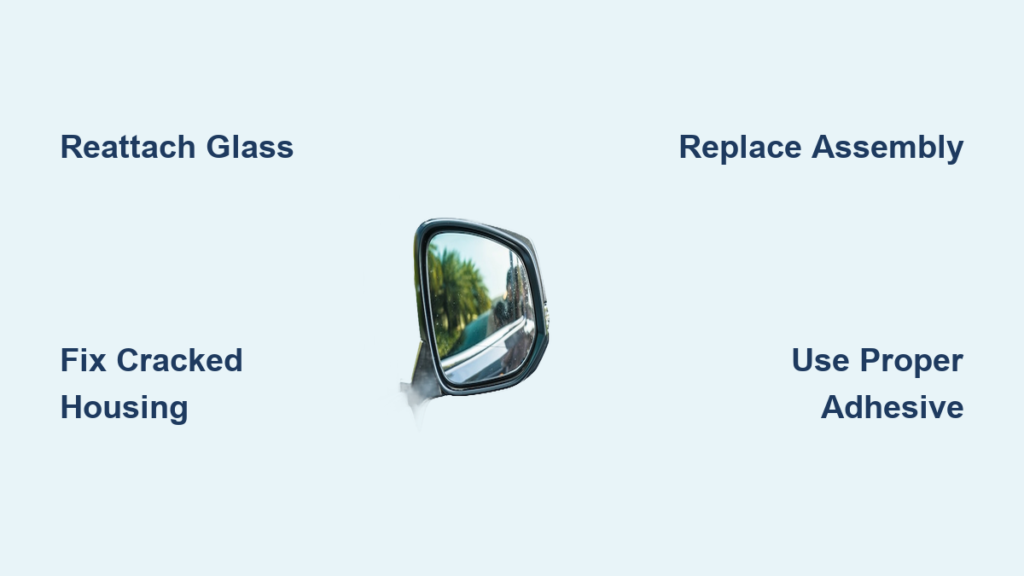
A broken car mirror doesn’t have to mean a costly trip to the dealership. Whether your side mirror was knocked loose in a tight parking spot, cracked by flying debris, or completely snapped off, most damage can be repaired or replaced affordably. The key is knowing which fix matches your damage type, from reattaching loose glass with strong adhesive to replacing the entire assembly. This guide walks you through every repair method, backed by real-world results and expert tips.
Diagnose Your Mirror Damage Type
Before grabbing tools, identify exactly what is broken. The wrong fix can fail fast or compromise safety.
Check for Glass Detachment
If the reflective glass is loose but the housing and adjustment controls still work, it likely just popped off the backing plate. This is common in mid-2000s Volkswagen models. Look for gaps around the edges or wobbling when touched.
Identify Cracked or Shattered Glass
Hairline cracks reduce visibility and worsen over time. Shattered glass should not be repaired. Even small fractures distort vision and weaken structural integrity.
Inspect Housing and Mounting Points
Check the plastic casing for deep cracks, especially near bolts or hinges. If the housing is split where it attaches to the door, mechanical reinforcement or full replacement is needed.
Test Electrical Functions
Turn on the car and try adjusting the mirror. If it does not move, the motor may be damaged. If folding, heating, or turn signal features fail, wiring or internal components are likely compromised.
Confirm Mounting Bracket Integrity
If the mirror hangs loosely or wobbles, check the bolts securing it to the door. Missing, stripped, or broken bolts require rethreading or bracket replacement. Never drive with a mirror that could detach at speed.
Repair vs. Replace: Make the Right Call
Choosing between repair and replacement saves time, money, and frustration.
Repair When These Conditions Exist
• Mirror glass separated from backing plate
• Minor cracks not near mounting bolts
• Loose cover or housing that can be snapped back
These issues are perfect for DIY fixes using adhesive, screws, or tape. You will keep original functionality and save significant money.
Replace When These Conditions Exist
• Entire mirror snapped off the door
• Cracks near bolt holes or hinges
• No power to adjustment, heating, or turn signal
• Exposed or frayed wires
In these cases, replace the full assembly. Aftermarket units start at $50, and OEM parts from salvage yards cost as little as $20.
Reattach Loose Mirror Glass (DIY-Friendly)

This is the most common fix. Mirror glass pops off but the motor and housing are fine.
Gather the Right Tools
• Plastic pry tool or flat screwdriver wrapped in tape
• Isopropyl alcohol wipes
• Lint-free cloth
• Two-part epoxy or automotive double-sided tape
• Hairdryer (optional)
Avoid super glue. It is brittle and fails under vibration.
Remove the Old Glass Safely
Tilt the mirror up to expose the bottom edge. Slide the pry tool behind the glass and gently twist. Work your way around until it releases. Do not force it. You could damage the motor.
Clean Surfaces Thoroughly
Wipe the backing plate and back of the glass with alcohol. Remove all dust, oil, or old adhesive residue. Let dry completely. This step is critical. Any contamination cuts bond strength by 50% or more.
Choose Your Adhesive Method
Use epoxy for long-term hold. Mix two-part epoxy and apply a thin layer to the backing plate. Press the glass in place and hold for 30 seconds. Let cure 4 to 24 hours. Strength reaches up to 3,000 psi, stronger than the original bond.
Use double-sided tape for speed. Apply heat-activated 3M VHB tape to the glass. Warm it with a hairdryer to activate. Align carefully and press firmly. This works for quick fixes but may fail in extreme temperatures.
Final Check
Once set, test mirror movement. If it binds or makes noise, the glass is misaligned. Remove and reapply.
Fix a Cracked or Loose Housing

Minor plastic damage can often be repaired without replacing the whole unit.
Assess Crack Location
Hairline cracks on the outer edge are repairable. Cracks near bolt holes or hinges require housing replacement. Structural failure risks complete detachment.
Repair with Plastic Epoxy
Clean the area with alcohol. Apply automotive-grade plastic epoxy to the crack. Smooth with a popsicle stick. Clamp or hold for 1 to 2 hours until set. Sand with 600-plus grit paper and apply touch-up paint.
Reattach a Loose Cover
If the outer shell is loose but clips are intact, snap it back. If clips are broken, use micro-sized 3M VHB pads along the inner rim. Avoid hot glue. It melts in direct sunlight.
Reinforce with Screws and Washers (Budget Fix)
When epoxy fails or the mirror is cracked but still attached, mechanical reinforcement works.
Pick the Right Drill and Screws
Use a precision drill bit slightly smaller than your screw diameter. Choose black self-tapping screws sized to match housing thickness. Use wide flat washers. They distribute pressure and prevent cracking.
Drill Pilot Holes Carefully
Select two stable points on the housing. Avoid moving parts and wires. Drill straight through. Do not rush. Uneven holes cause stress fractures.
Install Screws with Washers
Slide a washer under each screw head. Insert and tighten firmly but not fully. Overtightening shatters plastic. Once secure, apply outdoor-rated black silicone around each screw head and hole.
Seal and Finish
Let silicone cure for 24 hours. It waterproofs and absorbs vibration. For appearance, paint over with matching black spray paint.
Replace the Full Mirror Assembly
When the mirror is gone or deeply damaged, full replacement is fastest and safest.
Buy the Right Part
OEM parts offer the best fit, color, and durability. Used OEM from salvage yards is often cheaper than new aftermarket. Aftermarket units cost $50 to $120, but quality varies. Many rattle or fade quickly.
Gather Required Tools
• Socket wrench (usually 10mm)
• Trim removal tools
• Screwdriver set
• Electrical tape or heat shrink tubing (if splicing wires)
No special tools are needed for most vehicles.
Remove the Door Panel
Unscrew 2 to 4 visible screws. Use trim tools to gently pop out plastic clips. Pull the panel away. Do not disconnect wiring unless necessary.
Unbolt and Disconnect the Old Mirror
Behind the panel, locate the mirror’s 3 to 4 mounting bolts. Remove them. Unplug the electrical connector. If wires are cut, strip ends and prepare for splicing.
Install the New Mirror
Position the new mirror on the mounting plate. Insert and tighten bolts. Reconnect the harness. Match the plug orientation. If splicing, use heat shrink tubing, not electrical tape.
Reinstall the Door Panel
Route wires carefully. Snap the panel back into place. Reinsert screws.
Test All Functions
Turn on the car. Test mirror adjustment, folding, heating, and turn signal. Listen for grinding or resistance. Some models may need electronic calibration.
Try a Temporary Fix (Emergency Only)
Need to drive now? Stabilize the mirror fast.
Use Zip Ties and Duct Tape
Thread heavy-duty zip ties through existing holes. Double them for strength. Wrap densely with duct tape for waterproofing. Add foam pipe insulation behind the base to reduce vibration.
Build a Wire Frame
Bend a coat hanger into an H shape. Position arms outside the mirror. Secure with zip ties. This adds mechanical grip without drilling.
Cover with a Soda Bottle
Cut the top off a 2-liter bottle. Fit it over the repair like a dome. Tape it down. Paint black for a less obvious look.
This is not safe for long-term use. Avoid highways and rough roads.
Choose the Best Adhesive for Lasting Results
Not all glues work. Use the right one for your repair.
Best for Glass Reattachment: 3M VHB Tape
Heat-activated, automotive-grade double-sided tape holds 4 to 8 pounds per inch. Apply warm, press firm, and let set.
Best for Housing Cracks: Two-Part Epoxy
JB Weld or plastic-specific epoxy resists heat, moisture, and vibration. Lasts years if surfaces are clean.
Avoid: Super Glue and Hot Glue
They are brittle, fail under stress, and do not handle temperature swings.
Prevent Future Mirror Damage
Avoid repeat repairs with smart habits.
Fold Mirrors in Tight Spaces
Use the auto-fold feature or manually tuck them in when parking close to walls or other cars.
Avoid High-Pressure Washes
Do not blast mirror edges with a power washer. Water can seep in and degrade adhesives.
Thaw Frozen Mirrors Gently
Use de-icer or a warm cloth. Never force a frozen mirror. It can crack the motor.
Inspect Mounting Bolts Periodically
Check for tightness regularly. Vibration loosens fasteners over time.
When to See a Professional
Skip DIY if you see burnt wires or electrical shorts, grinding noises from the folding motor, broken mounting bracket at the door, or need for electronic calibration on BMW, Mercedes, or Tesla vehicles.
Mechanics have scan tools and OEM access. Expect $200 to $500 or more for labor and parts.
Frequently Asked Questions About Fixing a Broken Car Mirror
Can I use tape to fix a broken car mirror?
Yes, but only as a temporary measure. Duct tape and zip ties can stabilize a loose mirror for short-term use. This is not safe for long-term use or highway driving.
How long does glue last on a car mirror repair?
Glue repairs typically last a few days to a few weeks. Environmental factors like heat, cold, and moisture reduce longevity. Epoxy bonds can last years if surfaces are properly cleaned.
Is replacing the whole mirror cheaper than repairing?
Often yes. Aftermarket assemblies start at $50, and used OEM parts cost as little as $20. When electrical components are involved, replacement is often faster and safer than patching.
Do I need OEM parts for mirror replacement?
No, but OEM or used original parts typically perform better than aftermarket units. Many aftermarket mirrors rattle, fade quickly, or have poor fitment.
How long does a DIY mirror repair take?
Mirror glass replacement takes 10 to 20 minutes. Full assembly replacement takes 15 to 45 minutes for beginners. Some models may require calibration.
Can I drive with one side mirror broken?
Most regions allow driving with the interior mirror and one functional side mirror. However, visibility and safety are compromised. Repair promptly to avoid fines.
Key Takeaways for Fixing Your Broken Car Mirror

Most broken car mirrors can be fixed affordably with the right approach. Start by diagnosing the damage type. Loose glass reattached with epoxy or 3M VHB tape preserves electrical function and costs under $10. Cracked housing can often be repaired with plastic epoxy and silicone reinforcement. When the mirror is completely detached or electrical systems fail, full assembly replacement is typically easier and cheaper than expected, especially with used OEM parts from salvage yards.
Clean all bonding surfaces thoroughly with alcohol before applying adhesives. Use wide washers with screws to prevent cracking. Seal all holes with outdoor-rated silicone to prevent moisture damage. Take photos during disassembly to help with reassembly. For mirrors with cameras or blind-spot sensors, replacement may require professional calibration.
With proper technique and attention to detail, nearly every type of car side mirror damage can be repaired effectively, safely, and affordably.