Hanging a large mirror can completely transform a room, adding light, depth, and visual appeal. But a 72×48-inch mirror can weigh over 60 pounds, and if you mount it incorrectly, it risks falling, damaging your walls, or causing injury. How to put up a large mirror the right way depends on your wall type, the mirror’s weight, and choosing proper hardware that can handle the load. This guide walks you through every step using proven methods like J-channels, French cleats, and toggle bolts. You’ll learn how to assess your wall, select the right fasteners, align your mirror perfectly, and avoid common mistakes that leave mirrors crooked or unsafe.
Assess Your Wall Type Before Hanging
:strip_icc()/bhg-how-to-use-a-stud-finder-02-9374_8Y4oPNswqhE9MwCJZG7hG--2898ef772beb47a982cdd8ad566f7d0f.jpg)
Before you pick up a drill, you need to identify what lies behind your drywall. The wrong anchor on the wrong surface leads to failure every time.
Drywall Requires Studs or Heavy-Duty Anchors
Standard drywall is hollow and cannot support heavy loads alone. If your mirror exceeds 30 pounds, you must anchor into studs or use toggle bolts rated for the weight.
• Thumbtack test: Press a thumbtack into the wall. If it goes in easily, you are working with drywall.
• Stud spacing: Wall studs are typically 16 or 24 inches apart. Use a stud finder to locate them.
• Load limits by anchor type:
– Plastic anchors: 20 to 25 pounds
– Toggle bolts: 50 pounds or more
– Red wall anchors: Up to 50 pounds when installed correctly
Pro Tip: Mark stud edges with a pencil. Screwing too close to the edge can crack the drywall.
Plaster and Lath Need Special Anchors
Homes built before the 1940s often have plaster walls, which are hard but brittle. Standard anchors will crack the surface.
• Best fastener: Toggle bolt with spring-loaded nut
• Use a masonry bit to drill through the plaster
• The nut expands behind the lath, gripping the back of the wall securely
• This method supports 60-pound mirrors when installed properly
Brick or Concrete Demands Aggressive Drilling
Dense masonry surfaces require a hammer drill and the right fasteners.
• Use a hammer drill with a 5.5mm masonry bit
• Fasten with Tapcon screws or masonry anchors
• No anchors are needed if screws embed at least 1 inch into solid masonry
Solid Wood or Studs Are Ideal Mounting Surfaces
Direct screwing into wood studs provides the most secure installation.
• Use 2-inch deck screws with no anchors required
• Screws should penetrate at least 1 inch into the stud
• This method is always preferred for heavy mirrors
Safety First: Wear gloves and goggles when drilling or handling glass.
Determine Mirror Weight and Load Requirements
You cannot choose hardware until you know exactly how much weight you are dealing with.
Weigh the Mirror Before You Start
• Use a bathroom scale for smaller mirrors
• Check product specifications online for exact weight
• Estimate using these benchmarks:
– 24×60-inch framed mirror: approximately 24 pounds
– 72×48-inch mirror: 60 pounds or more — treat this as heavy-duty
Rule of thumb: If the mirror exceeds 30 pounds, assume it is heavy and plan accordingly.
Choose Hardware Rated 25% Higher Than Mirror Weight
Safety margins prevent catastrophic failure.
• 40-pound mirror? Use hardware rated for 50 pounds or more.
• Never rely on adhesive strips like Command products for large mirrors. They fail under humidity, vibration, and load creep over time.
Pick the Right Mounting Method for Your Situation
The best method depends on mirror size, weight, wall type, and whether you plan to remove it later.
Install J-Channel for Full-Wall Mirror Arrays
J-channel works best for dance studios, home gyms, or rental properties where mirrors need to be removable and perfectly aligned.
Why J-Channel Works
• The mirror slides into a vertical track with no fasteners needed at the bottom
• The top edge secures with clear plastic clips that are nearly invisible
• This system allows perfect alignment of multiple mirror panels
• It causes no wall damage at the base, making it ideal for rentals
J-Channel Installation Steps
- Locate studs along the mirror’s intended path
- Cut aluminum J-channel to match the height, typically floor to ceiling
- Align the channel with studs, then screw into place using 2 to 3-inch deck screws
- Slide the mirror’s bottom edge into the groove
- Secure the top with plastic clips attached to the wall or baseboard
Depth matters: Match J-channel depth to mirror thickness. Use ¼-inch for thin mirrors, 5/16-inch or ½-inch for standard or thick glass.
Pro Tip: Keep the screwdriver behind the screw head when driving above eye level. This prevents slippage that could crack the mirror.
Hang Heavy Mirrors with a French Cleat
French cleats work best for mirrors over 40 pounds or wall-to-wall installations.
How a French Cleat Works
The system uses two interlocking brackets. One mounts on the wall while the other attaches to the mirror back. Both are cut at 45-degree angles so they lock together when slid into position. The mirror sits flush against the wall and resists shifting.
French Cleat Installation Steps
- Attach the wall cleat, ensuring it is level and screwed directly into studs
- Attach the mating cleat to the mirror frame
- Lift the mirror and slide the wall cleat into the mirror cleat
- Check level and adjust if needed
- Secure with additional screws if the design allows
Precision is key: Measure twice. A misaligned cleat means the mirror will not seat properly.
Hang Moderate Mirrors with Dual Hooks and Wire
Use this method for single large mirrors that already have D-rings and hanging wire attached.
Why Two Hooks Beat One
• Two hooks allow leveling and better weight distribution
• This prevents tilting and reduces stress on anchors
How to Position Hooks Correctly
- Place a 12-inch scrap of wood against the mirror back
- Mark where the hanging wire touches the wood
- Measure down from the top of the mirror to that point
- Transfer that distance to the wall for your hook height
- Mark both hook locations, matching the wire span
- Install hooks so the bottom of the hook aligns with your mark
Use braided steel wire: It is stronger than nylon or thin cable.
Mount on Drywall Without Studs Using Toggle Bolts
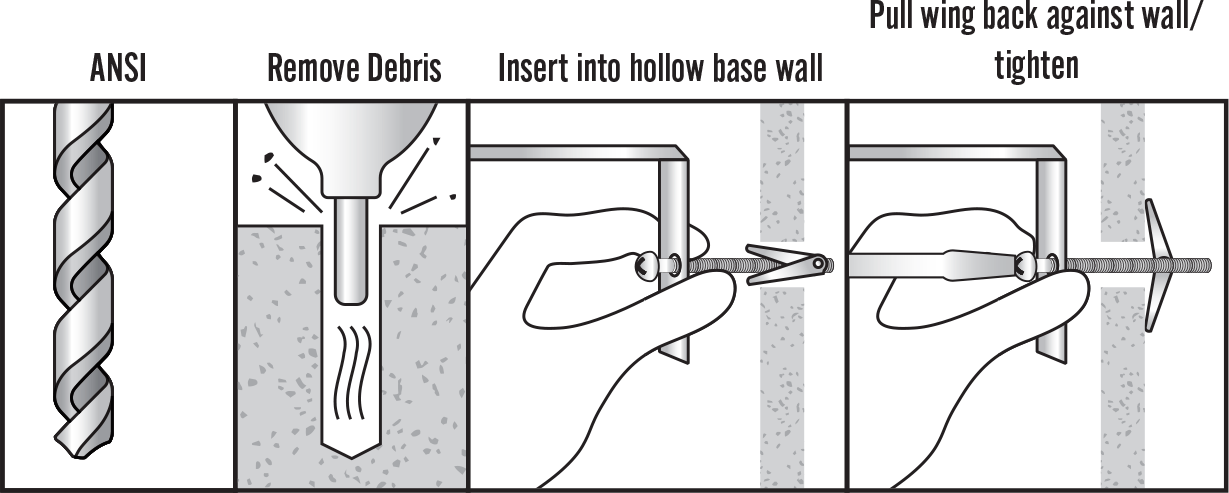
When studs do not align with your hanging points, toggle bolts provide the strongest hold.
How Toggle Bolts Work
• Insert the bolt through a drilled hole
• The spring-loaded nut expands behind the wall
• Tighten the bolt from the front to secure the anchor
Toggle Bolt Installation Steps
- Drill a hole sized per bolt specifications
- Insert the toggle bolt with the nut in the closed position
- Push through until the nut opens behind the wall
- Tighten the bolt with a screwdriver
- Attach a picture hook to the threaded end
- Hang the mirror
Tested strength: Toggle bolts support 60-pound mirrors on both drywall and plaster.
Never Rely on Adhesive Alone
Adhesive mounting has very limited applications and should never be the only method for large mirrors.
When Adhesive Can Help
• Mirror mastic can supplement mechanical fasteners
• Apply only in dry, clean, flat areas
• Use for light stabilization only, never as the primary load-bearing method
Why Adhesive Strips Fail
• Command strips fail under humidity, vibration, and load creep over time
• Never use them for mirrors exceeding 20 pounds
Best practice: Combine J-channel or cleat with light adhesive for extra security. Never reverse this order.
Step-by-Step: Hang a Large Mirror Safely
Follow this sequence for a secure, level installation every time.
Prepare the Wall and Mirror
• Remove old fixtures like TVs or shelves
• Label wires before disconnecting them
• Cover old holes with cut blank wall plates to preserve the wall for future use
• Patch screw holes with joint compound that dries in about 20 minutes
• Clean the wall surface if using adhesive
• Apply felt or rubber bumpers to the mirror back corners to prevent wall scratching
Critical: Always use at least one helper for mirrors over 30 pounds.
Measure and Mark Placement
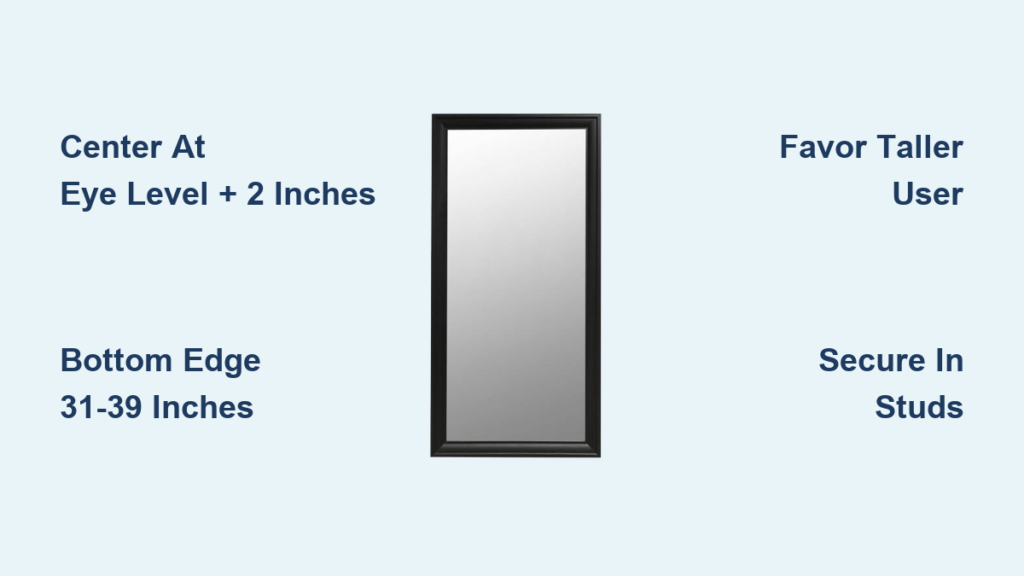
Set Ideal Mirror Height:
• Average eye level is 57 inches from the floor
• Adjust for function: lower above dressers, higher in hallways or gyms
Find Wall Center:
1. Measure between wall edges and divide by two
2. Mark the midpoint
3. Use a level or straight timber to transfer the center to the wall
Mark Hanging Points:
• Measure distance between D-rings or brackets
• Find the center and mark on timber
• Align timber center with wall center
• Mark hook or cleat positions at the correct height
Install Anchors and Screws
• Drill pilot holes using the correct bit size for your anchors
• Wrap tape around the drill bit to control depth and prevent drilling too far
• Insert anchors for drywall or plaster: use toggle bolts or red anchors
• For masonry: use Tapcon screws with a hammer drill
• Drive 2-inch screws for drywall with anchors, or deck screws directly into studs
Avoid over-tightening: This can crack drywall or plaster.
Hang the Mirror
• Never go solo for mirrors over 30 pounds. Use gloves for grip and protection.
• For wire systems: lower gently, ensuring both sides seat on hooks
• For cleat systems: slide wall cleat into mirror cleat
• For J-channel: guide the bottom edge into the groove, then secure the top
• Check level using a 6-foot level. Short levels give false readings on large mirrors.
• Adjust by loosening screws slightly and repositioning.
Test Stability and Inspect
• Push gently on corners. There should be no movement or shifting.
• Inspect the wall for cracks or stress marks.
• Tighten screws every 6 to 12 months.
• Check anchors for loosening annually.
Warning: Never hang heavy mirrors above beds or sofas unless anchored into studs.
Avoid These Common Mistakes
Using Weak Hardware
• Risk: Mirror falls and causes injury
• Fix: Use hardware rated 25% above mirror weight
Skipping the Stud Finder
• Risk: Wall damage and instability
• Fix: Always locate and mark studs first
Installing Alone
• Risk: Dropping the mirror or back strain
• Fix: Get at least one helper for mirrors over 30 pounds
Misleveling
• Risk: Poor appearance and stress on the frame
• Fix: Use a 6-foot level and double-check alignment
Over-Tightening Screws
• Risk: Cracked drywall or damaged frame
• Fix: Tighten securely, not excessively
When to Call a Professional
Hire a pro if the mirror weighs over 40 pounds, is wall-to-wall or floor-to-ceiling, the wall is brick, concrete, tile, or old plaster, no studs align with hanging points, or you lack tools, experience, or a helper.
Pros Offer These Advantages
• In-home consultation and custom measurements
• Commercial-grade tools and hardware
• Low-damage methods for renters
• Patching and restoration advice
Frequently Asked Questions About Putting Up Large Mirrors
What is the safest way to hang a heavy mirror?
The safest method depends on your wall type. For drywall, anchor into studs whenever possible. For heavy mirrors over 40 pounds, a French cleat system provides the most secure installation. Always use hardware rated for 25% more than the mirror’s weight.
Can I hang a large mirror on drywall without studs?
Yes, using toggle bolts. Toggle bolts have spring-loaded nuts that expand behind the wall, supporting 60 pounds or more. They work on both drywall and plaster when studs are not available at your hanging points.
How do I find the right height for hanging a mirror?
The ideal height is 57 inches from the floor, which matches average eye level. Adjust lower for mirrors above dressers or vanity areas. Keep higher for hallway or gym mirrors where full-body viewing is needed.
Can I use adhesive strips to mount a large mirror?
No. Adhesive strips like Command products fail under humidity, vibration, and load creep over time. They should never be the primary mounting method for mirrors over 20 pounds. Use mechanical fasteners instead.
How do I remove a large mirror without damaging the wall?
Use removable systems like J-channel or French cleats. For J-channel, remove the top clips first, then slide the mirror out. For toggle bolt installations, simply remove the bolts and patch the holes with joint compound.
Key Takeaways for Hanging Large Mirrors
Hanging a large mirror successfully comes down to three critical steps. First, always assess your wall type and determine mirror weight before selecting any hardware. Second, choose a mounting method matched to your situation: J-channel for full-wall arrays, French cleats for heavy mirrors, or toggle bolts when studs are not available. Third, anchor into studs whenever possible and use hardware rated for 25% more than your mirror’s weight.
The most common mistakes are using weak hardware, skipping the stud finder, and attempting to install alone. These lead to mirrors falling, walls getting damaged, or personal injury. Take your time with measurements, use a 6-foot level for accuracy, and always get help for mirrors over 30 pounds.
For rental properties, choose removable systems like J-channel that cause minimal wall damage. For bathrooms, use waterproof-rated anchors and mechanical fasteners rather than adhesive. If your mirror exceeds 40 pounds, is wall-to-wall, or your wall is brick, concrete, or old plaster, hire a professional to ensure a safe and secure installation.