Leaning a mirror against the wall is more than just a quick decor hack. It is a design choice that adds depth, reflects light, and creates an effortlessly elegant look in any room. Unlike mounted mirrors, leaning mirrors offer flexibility, easy repositioning, and a relaxed vibe perfect for bedrooms, living rooms, or entryways. But without proper stabilization, even a beautiful full-length mirror can become a hazard. A sudden bump, pet jump, or slippery floor can send it crashing to the ground.
This guide covers everything you need to know about how to lean a mirror safely. You will learn how to choose the right mirror, place it securely, and stabilize it without drilling. Whether you are renting, avoiding tools, or just love the laid-back aesthetic, these proven techniques ensure your mirror stays upright, stable, and stunning for years to come.
Choose the Right Mirror for Leaning

Selecting the right mirror is the foundation of a safe, stylish lean. The size, weight, and frame material all determine how well the mirror will stay in place.
Pick the Ideal Size and Weight
For full-length functionality and visual impact, opt for a mirror that is at least 60 inches tall. The mirror should feel proportional to nearby furniture. Its width should not exceed the sofa, console, or bed it is placed beside.
Weight matters significantly for stability. Mirrors under 10 to 14 pounds may stay put on carpet but can slide on hardwood. Those over 15 pounds need anchoring. Mirrors above 50 pounds should always be secured to wall studs. Never rely on friction alone for heavier models.
Select a Stable Frame and Backing
The frame and backing matter just as much as size. Solid wood, MDF, or reinforced metal frames handle leaning stress better than hollow or thin materials. Avoid flimsy backs that flex or warp over time.
Frameless or slim-framed mirrors tend to wobble and require extra support. If you love the clean look, pair it with non-slip pads and wall anchors. For both style and stability, consider matte black metal, brass, or antique wood frames. These add weight and visual grounding to the space.
Match Shape to Your Space
Rectangular and oversized mirrors are most common and stable when leaned. Arched mirrors add elegance and draw the eye upward. They work especially well in rooms with high ceilings.
Round or irregularly shaped mirrors are harder to balance and rarely leaned without custom brackets. If you must use one, anchor it securely and place it in low-traffic zones. Use painter’s tape on the floor to test the footprint before buying.
Pick the Best Room and Spot
Not all environments are equally suited for leaning mirrors. Choosing the right room and specific location is critical for both aesthetics and safety.
Ideal Rooms for Leaning Mirrors
Bedrooms are perfect for leaning mirrors, especially near wardrobes or dressing areas. They reflect natural light and create a hotel-like feel. Place behind or beside the bed to amplify the sense of space.
Living rooms benefit from the added depth. Lean beside a sofa to reflect a fireplace, artwork, or window. The angled surface captures more of the room than a flat-mounted mirror.
Spacious entryways or dressing areas can handle full-length mirrors without crowding. They double as functional check-your-look stations and design statements.
Avoid Risky Locations
Skip narrow hallways. These are high-traffic zones where mirrors can easily get bumped. Small or cluttered rooms feel more cramped with a floor-standing mirror. In these cases, opt for wall-mounted instead.
Avoid slippery floors like polished tile or glass without grip aids. Carpeted or uneven surfaces can cause tipping unless stabilized. Bathrooms with moisture may damage wood frames or backing over time unless the space is well-ventilated.
Position the Mirror Correctly
Once you have the right mirror in the right room, proper positioning ensures both safety and visual appeal.
Use a Safe Leaning Angle
The ideal lean is 5° to 15° from vertical. Too shallow, and the mirror may pull away from the wall. Too steep, and it risks tipping forward.
Rest the top edge gently against the wall and the base firmly on the floor. Test stability by lightly pushing the top. If it wobbles or slides, it needs support.
Ensure the wall is clean and flat. A dusty or textured surface reduces contact and increases slip risk. Wipe it down before placement.
Secure the Mirror Without Drilling
Stabilization is essential. Even heavy mirrors can fall from vibrations, bumps, or pet activity. Here are proven no-drill methods.
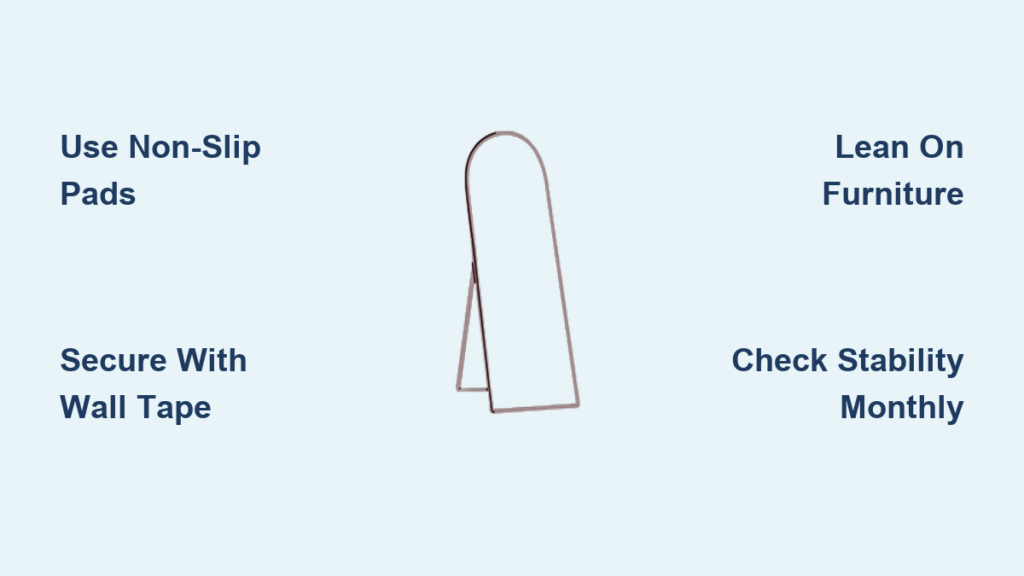
Use Non-Slip Pads at the Base
Non-slip pads prevent forward sliding, especially on hardwood or tile. Apply rubber, felt, or silicone pads to the bottom corners of the mirror’s frame, not the floor. This allows for easy repositioning.
GorillaPads are highly effective peel-and-stick rubber discs. Users report they stay put even when other adhesives fail. Cut silicone strips or mats to size for full-base coverage.
Avoid placing bare glass or metal directly on slick surfaces. Even heavy mirrors can shift from vibrations or foot traffic.
Try Adhesive Wall Anchoring
Prevent tipping with heavy-duty mounting tape or adhesive zip ties. These are rental-friendly and leave minimal damage.
Use Gorilla Tough and Clear XL Mounting Tape for medium mirrors. Press firmly and wait 24 hours for full adhesion. Check reviews first, as some users report peeling over time, especially in humidity.
Adhesive zip tie mounts work better. Stick small anchors to the wall near the mirror’s top. Loop a zip tie through the frame’s hanging hardware. Leave slight slack. Constant tension weakens the adhesive. This method is discreet and strong when done right.
Pro Tip: Test placement first. Use painter’s tape to mark where the zip tie anchors go. Remove slowly to avoid paint damage.
Lean on Furniture for Dual Support
For maximum safety, mount the mirror on the wall 7 inches above a table or console, letting the bottom rest on the surface. It looks leaned but will not fall.
This hybrid method distributes weight and eliminates tipping risk. One user confirmed that with this method, the mirror will never fall. It works with any mirror weight and is ideal for high-traffic areas.
Add Decorative Stabilizers With Limits
Place heavy objects like marble sculptures, stone bowls, or stacked books in front of the base to block forward movement.
But do not rely on this alone. One user reported a 14-pound mirror slid despite front weights, shattering a nearby glass planter. Only use this for light mirrors in low-traffic areas.
Protect Floors and Walls

Taking care of your surfaces ensures your mirror stays in good condition while preventing damage to your home.
Prevent Floor Scratches
Even with pads, mirrors can scuff hardwood or tile. Place a felt pad, rubber stopper, or non-slip rug under the base. Avoid loose or frayed rugs that shift.
For extra grip, use a textured mat or underlay beneath the mirror’s feet. This is especially important on glass-top tables or polished stone.
Avoid Wall Damage
The mirror’s top edge can rub against the wall, leaving marks. Apply a thin strip of painter’s tape where it touches. It is removable and prevents scuffing.
If using adhesive anchors, plan for paint touch-ups when removing. Use wall-friendly products and pull slowly at a 45° angle to minimize damage.
Prioritize Safety in Risky Homes
Some households require extra precautions. Tailor your stabilization approach to your specific situation.
Protect Against Pets and Kids
Cats may jump on mirrors, especially if placed near windows or furniture. Children may push or climb them. Never leave unsecured mirrors in pet or child-accessible areas.
If you have active pets, avoid leaning mirrors unless anchored to wall studs. Consider switching to wall-mounted versions in playrooms or cat zones.
Secure Mirrors in Earthquake Zones
In seismic areas, adhesive-only solutions are not enough. Use furniture anchoring straps screwed into wall studs. These are designed to hold top-heavy furniture and mirrors.
If you cannot drill, permanently mount the mirror with picture hooks and wall anchors. Safety outweighs aesthetics in high-risk zones.
Style the Mirror Like a Pro
A leaning mirror is not just functional. It is a design statement. Use these tips to maximize visual impact.
Pair with Furniture and Decor
Lean behind a sofa, console, or bench to create depth. The reflection doubles the furniture and opens the room visually.
Place beside a bookshelf or plant stand to amplify greenery and textures. Drape a scarf or shawl over the frame for bohemian flair.
Use as a backdrop for a reading nook, vanity, or seasonal display. The angled surface adds dimension to flat walls.
Maximize Light and Space
Angle the mirror to reflect natural light from windows. This brightens dark corners and reduces the need for artificial lighting.
Bounce floor lamp or sconce light across the room. A well-placed mirror can make a small space feel twice as large.
Create a Layered Look
Layer with wall art, floating shelves, or textiles. Hang a small painting above or place plants in front.
Add a rug or stool in front to define the area. Rotate mirrors seasonally. Swap sizes or styles for holidays or events.
Maintain Long-Term Stability
Regular maintenance keeps your mirror secure over time. Do not set it and forget it.
Inspect Monthly
Check adhesives, pads, and zip ties every month. Look for peeling, warping, or loosening. Reapply or replace as needed.
Clean the mirror base and wall contact points before reapplying tape. Dust and oils reduce grip.
Reapply Adhesives in High-Humidity Areas
Bathrooms or sunrooms may degrade adhesives faster. Use moisture-resistant tape or switch to mechanical anchors.
In high-traffic zones, upgrade to L-brackets or anti-tip straps for lasting security.
Leaning vs. Mounted Mirrors: Which Is Better

Understanding the trade-offs helps you choose the right option for your space.
| Feature | Leaning Mirror | Mounted Mirror |
|---|---|---|
| Installation | No tools, easy to move | Requires drilling and anchors |
| Safety | Risk of tipping; needs stabilization | Secure, fixed position |
| Aesthetic | Casual, relaxed, editorial | Clean, structured, permanent |
| Space Use | Uses floor space | Frees up floor space |
| Flexibility | Easy to reposition and angle | Fixed angle and location |
| Best For | Bedrooms, living rooms, rentals | Bathrooms, hallways, small rooms |
Leaning mirrors win for flexibility and style. Mounted mirrors win for safety and space-saving. Choose based on your room, lifestyle, and risk tolerance.
Best Stabilization Methods Summary
Different situations call for different solutions. Choose what works best for you.
| Method | Best For | Effectiveness |
|---|---|---|
| Non-slip pads | Light mirrors on hardwood | Medium |
| Mounting tape | Renters, no-drill zones | Medium to High |
| Adhesive zip ties | Medium to heavy mirrors | High |
| Wall-mounted plus table | All weights, high-traffic | Very High |
| Decorative front weights | Light mirrors only | Low |
| Furniture straps (screwed) | Seismic zones, heavy mirrors | Highest |
Frequently Asked Questions About How to Lean a Mirror
Can I lean a mirror without it falling?
Yes, you can lean a mirror safely by using non-slip pads at the base, applying adhesive wall anchors, or combining the mirror with furniture support. For heavier mirrors over 50 pounds, always secure to wall studs. Even lightweight mirrors benefit from stabilization to prevent accidents.
What is the best angle for leaning a mirror?
The ideal leaning angle is 5° to 15° from vertical. The top edge should rest gently against the wall while the base sits firmly on the floor. Test stability by gently pushing the top. If it wobbles, add support.
How do I keep a leaning mirror from sliding on hardwood?
Apply non-slip pads to the bottom corners of the mirror frame. Products like GorillaPads work well on hardwood, tile, and laminate. Avoid placing bare glass or metal directly on slick surfaces.
Is it safe to lean a mirror in a bedroom with pets?
It depends on the pet. Cats may jump on or push mirrors. If you have active pets, either avoid leaning mirrors in accessible areas or secure them with wall anchors. Consider wall-mounted mirrors in playrooms or pet zones.
Can I use adhesive mounting tape for heavy mirrors?
You can, but with caution. Heavy-duty mounting tape works for medium mirrors, but reviews show mixed results over time, especially in humidity. For heavy mirrors over 50 pounds, screw-in anchors or furniture straps are more reliable.
How do I protect my wall when leaning a mirror?
Apply a thin strip of painter’s tape where the mirror touches the wall. This prevents scuffing and marks. If using adhesive anchors, plan for paint touch-ups when removing them. Pull tape slowly at a 45° angle to minimize damage.
Key Takeaways for Leaning Your Mirror
Leaning a mirror is a stylish design choice that works beautifully in bedrooms, living rooms, and entryways. The key to success lies in choosing the right mirror, placing it in an appropriate location, and stabilizing it properly.
Always use non-slip pads at the base to prevent sliding on hard floors. For added security, combine pads with adhesive wall anchors or use the wall-and-table hybrid method. This approach gives you the leaned look while virtually eliminating tipping risk.
Do not skip stabilization, even for heavy mirrors. A sudden bump, pet jump, or floor vibration can send an unsecured mirror crashing. Prioritize safety in homes with children, pets, or seismic activity.
With the right mirror, placement, and security measures, you can enjoy the beauty of a leaning mirror safely and stylishly for years to come.