You don’t need to replace your entire bathroom mirror to get a high-end look. Adding a custom frame can transform a plain, builder-grade mirror into a stylish focal point that looks like a professional renovation. Whether you are a renter looking for a removable upgrade or a homeowner investing in long-term value, how to make a bathroom mirror frame is a DIY project that costs as little as $10 and delivers dramatic visual impact in just a few hours.
This guide walks you through every step from measuring and cutting to sealing and installation. You will learn which materials hold up best in humid bathrooms, which adhesives actually bond to glass, and how to avoid the mistakes that cause frames to warp or detach.
Choose the Right Framing Material
Wood Types for Humid Environments
Selecting the right wood is the foundation of a durable bathroom mirror frame. Not all lumber handles moisture well, and choosing poorly will lead to warping and discoloration over time.
The best options include:
• Pine 1×3 or 1×4 boards are budget-friendly and easy to work with, making them ideal for beginners
• Primed poplar or MDF provides a knot-free surface that accepts paint beautifully and resists moisture
• Red oak offers rich grain and excellent durability, especially in fluted or profiled trim shapes
Avoid raw, unsealed softwoods completely. They swell, warp, and discolor when exposed to bathroom steam.
Pre-Primed vs. Bare Wood
Pre-primed trim saves significant time and ensures even paint adhesion across every surface. Bare wood requires sanding, priming, and additional sealing but provides full control over the final finish.
Regardless of your choice, all six sides of each board must be sealed to prevent moisture damage and warping. This includes the front, back, edges, and end grain.
Alternative Trim Options
For architectural flair without complex joinery, consider using pre-profiled trim pieces:
• Window casing or baseboard molding adds instant elegance with built-in detail
• Shoe molding layered against baseboard creates visual depth
• These pieces cut, finish, and attach just like standard lumber but look more custom
Measure and Cut with Precision
Accurate Mirror Measurements
Measure your mirror’s outer width and height at multiple points. Builder-grade mirrors are not always perfectly square, so record the largest dimensions you find.
The frame should overlap the glass by ¼ inch to ½ inch on all sides for a traditional framed appearance. This overlap hides the mirror edges completely and creates a cohesive look.
Calculate Board Lengths
For mitered corners, use these formulas to determine cut lengths:
• Top and bottom pieces: Mirror width plus two times the frame width
• Side pieces: Mirror height minus approximately 1.5 inches to account for the ¾-inch thickness of each board at the mitered corners
Example: For a 24-inch wide mirror with 3-inch wide trim, the top and bottom pieces would be cut at 30 inches. The side pieces would be cut to the mirror height minus the board thickness.
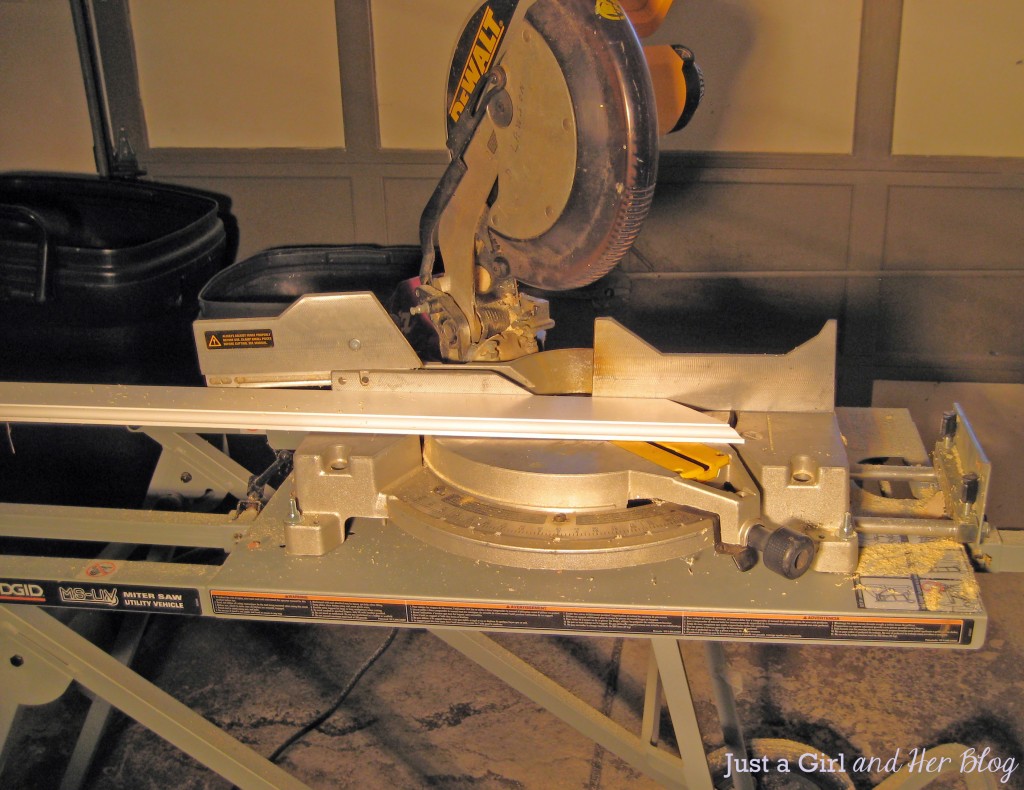
Use a Stop Block for Consistency
Attach a stop block to your miter saw fence before cutting. This simple device ensures every cut of the same length is identical, eliminating the frustration of mismatched corners that do not fit.
Cut all four pieces and test fit them on a flat surface before any gluing. Adjust lengths as needed.
Mitered vs. Butt Joints
Mitered 45-degree joints create a professional appearance but require precise cuts. Butt joints at 90 degrees are beginner-friendly and require no angle cutting. You can hide butt joint seams with paintable caulk or decorative L-brackets.
For your first project, butt joints are perfectly acceptable and still look clean when finished properly.
Notch Around Mirror Clips
Locate Existing Mirror Clips
Check the mirror edges for metal clips that hold the glass to the wall. These small hardware pieces will prevent the frame from sitting flush against the mirror surface.
Mark and Cut Notches
Hold each trim piece in position and mark exactly where clips intersect the back of the board. Use a sharp chisel to carve a ¼-inch to ½-inch deep notch in the back of the trim.
This notch allows the frame to sit flush against the mirror without lifting. Take your time with this step, as rushing causes uneven gaps.
Alternative method: Temporarily remove the clips, install the frame, then reinstall the clips behind the trim.
Assemble the Frame Correctly
Pre-Assembled Mitered Frame
This method produces the most professional results but requires more skill. Cut all pieces at 45 degrees, dry-fit them completely, then apply Titebond wood glue to the mitered ends.
Clamp corners securely or wrap with blue painter’s tape. Allow the glue to dry overnight. Reinforce joints with hidden corner braces or wood screws with decorative plugs.
On-Site Assembly Method
Ideal for renters or beginners, this method requires no power tools for assembly. Cut and finish each board separately, then attach them directly to the mirror one piece at a time using construction adhesive.
Apply adhesive to the back of each piece, press firmly against the mirror, and hold in place with blue painter’s tape until the adhesive sets. Start with side pieces, then add top and bottom.
Staple-Gun Butt Joint Method
For straight-cut boards, assemble on a flat surface. Apply wood glue to the joints, align the ends, and reinforce with a staple gun from the back. This creates a strong, hidden joint without requiring mitered cuts.
Rabbet Frame Method
This advanced technique requires removing the mirror from the wall. Cut a ½-inch wide by ¼-inch deep rabbet groove on the back of the frame pieces. Insert the mirror into the groove, secure from behind with pan-head screws and washers, and seal edges with white silicone.
Rehang the entire unit as one piece. This method produces the strongest and most professional result but requires the most skill and effort.
Sand and Finish for Longevity
Sand in Progressive Grits
Sand each board starting with 80-grit paper to remove imperfections, progress to 120-grit for smoothing, and finish with 240-grit for a polished surface. Wipe away all dust with a lint-free cloth between grits.
Prime Bare Wood and MDF
Apply latex or oil-based primer to block tannin bleed and improve paint adhesion. Let the primer dry completely, then lightly sand before applying your topcoat.
Paint or Stain Your Choice
For painted frames, apply two to three coats of latex paint in semi-gloss or satin finish. For stained frames, apply pre-stain conditioner first, then wipe on Minwax Early American or a similar stain, wiping off excess immediately.
Critical: Paint or stain the back edge of every trim piece. Unfinished wood reflecting in the mirror ruins the entire look.
Seal All Sides with Polyurethane
Bathroom humidity demands serious protection. Apply three coats of high-gloss polyurethane using a soft-bristle brush, sealing all six sides of each board. Lightly sand between coats with 240-grit paper.
High-gloss finish is easiest to clean and most resistant to moisture. Reapply this clear coat every two to three years in high-humidity bathrooms.
Install with the Right Adhesive
Clean the Mirror Surface
Wipe the mirror thoroughly with white vinegar or isopropyl alcohol. Remove all fingerprints, oils, and dust. Dry with a lint-free cloth.
Any contamination weakens the adhesive bond and causes premature failure.
Use Flexible, Waterproof Adhesive
Never use rigid five-minute epoxy. It cracks under the slight wood movement caused by humidity changes. Choose one of these proven options:
• Loctite PL530 Mirror and Glass Adhesive offers high flexibility and excellent moisture resistance
• Liquid Nails LN-905 is specifically formulated for mirrors and glass
• Gorilla Clear Glue provides a waterproof, flexible bond ideal for stained wood
Apply Adhesive Properly
Spread adhesive across the entire back surface of the trim. Keep the adhesive ¼ inch from the inner edge to prevent visible squeeze-out in the mirror reflection.
Avoid applying adhesive only in the center of the board. Full coverage ensures the strongest bond.
Mount the Frame Step by Step
Start with Side Pieces
Press the side trim pieces onto the mirror first. Slide slightly as you press to spread the adhesive evenly. Use blue painter’s tape or books to hold pieces in place while the adhesive sets.
Add Top and Bottom Last
Install top and bottom pieces after the sides are secure. This sequencing ensures even spacing and prevents misalignment that would make corners look uneven.
Allow 24 Hours to Cure
Do not touch or use the mirror for at least 24 hours. The bond continues strengthening over this time. Rushing this step risks the frame detaching.
Optional: Secure to Wall
If your mirror has mounting holes, apply paintable caulk into the holes before reinserting the fasteners. The frame itself does not need to bear structural weight, as the adhesive supports it entirely.
Seal Gaps and Prevent Moisture
Caulk the Corners
Fill any gaps at joints with paintable caulk. Smooth with a wet finger or caulk-smoothing tool. Let dry completely, then sand lightly and paint over for a seamless appearance.
Apply Silicone at the Bottom
Run a bead of clear or white silicone along the bottom edge of the frame where it meets the mirror. This simple step prevents water from wicking behind the wood, which is the most common cause of warping in bathroom installations.
Fix Common Mistakes
Imperfect Mitered Corners
Small gaps at mitered corners are normal and easily fixed. Apply paintable caulk to fill the gap, smooth it flush, and paint over. Most imperfections disappear completely with a clean finish.
Board Cut Too Short
If you cut a piece too short, do not use a straight butt splice to extend it. Instead, cut an angled splice joint at approximately 45 degrees, glue the overlap, and hide the seam on a bottom rail where it is least visible.
Reflection of Unfinished Wood
If you see unfinished wood reflecting in the mirror, the back edge was not finished. Remove the piece, paint the back edge flat black, and reinstall. This eliminates the reflection instantly.
Choose a Style That Fits Your Bathroom
Modern: Matte Black Frame
Spray-paint your trim with matte black primer and paint for high contrast against white walls and modern vanities. This style pairs particularly well with contemporary bathrooms.
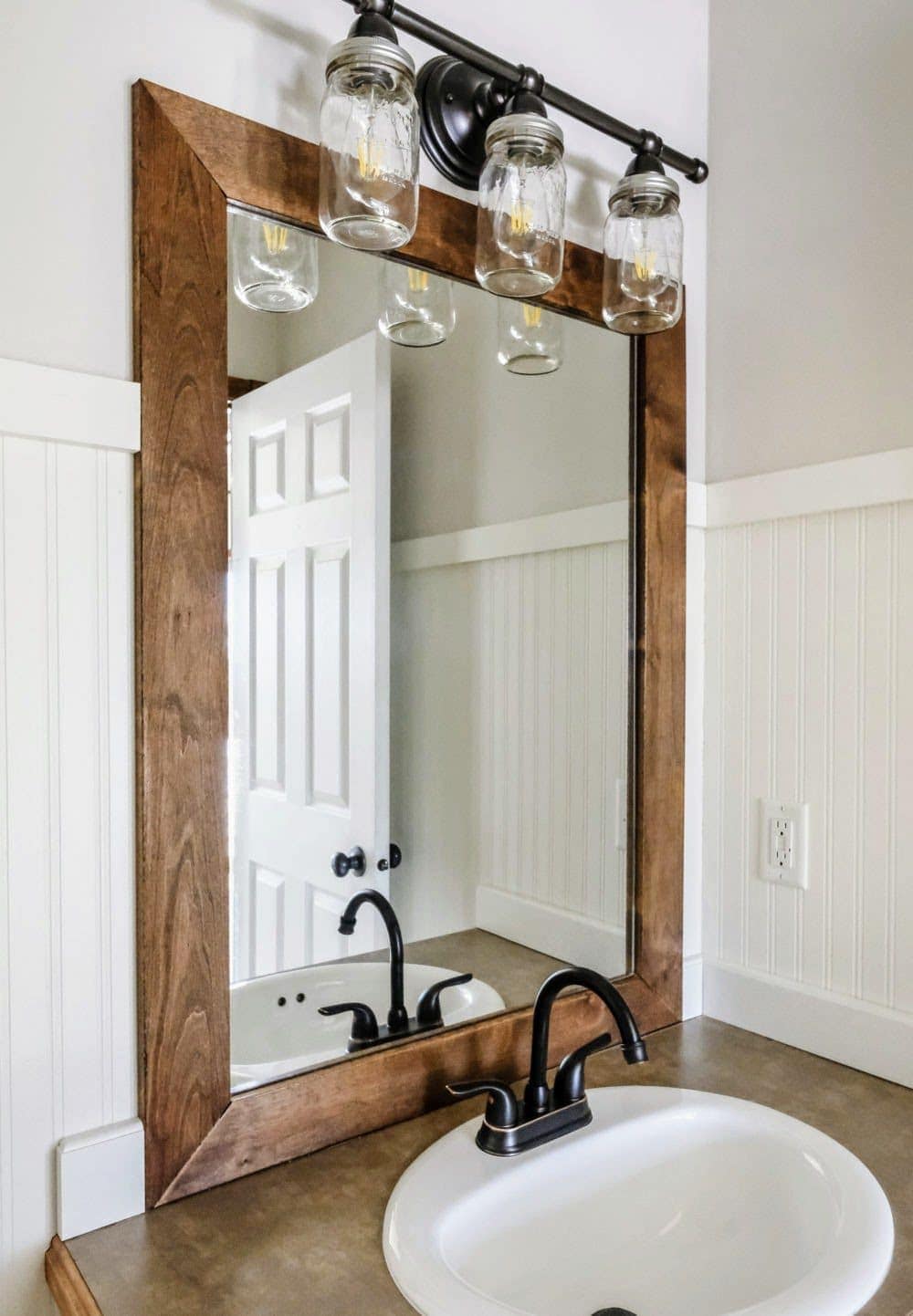
Rustic: Stained Natural Wood
Use red oak with Early American stain for warm, natural beauty. Apply extra coats of polyurethane for humidity protection in this finish.
Layered Trim Look
Combine baseboard with shoe molding for a built-in appearance. Attach with wood glue and brad nails, then caulk and paint the seams for a seamless look.
Color-Matched to Vanity
Paint the frame to match your cabinet color exactly. This creates a cohesive, custom-designed appearance throughout the bathroom.
Maintain Your Frame Long Term
Reapply Sealant Every 2-3 Years
In high-humidity bathrooms, refresh the polyurethane every few years. Lightly sand the surface, wipe clean, and apply one to two new coats.
Wipe Clean with Gentle Cleaners
Avoid abrasive pads or ammonia-based cleaners. Use a damp microfiber cloth with mild soap for regular cleaning.
Watch for Warping or Gaps
If the frame lifts or warps, check for unsealed edges or failed adhesive. Remove the affected piece, reseal all surfaces, and reattach with fresh adhesive.
Cost and Time Comparison
| Method | Cost | Time | Skill Level |
|---|---|---|---|
| On-site adhesive (beginner) | $10-$15 | 2-3 hours | Low |
| Pre-assembled mitered | $20-$45 | 3-4 hours | Moderate |
| Rabbet frame (advanced) | $30-$50 | 4-6 hours | High |
Compare these costs to store-bought frames ranging from $50 to $150 or mirror replacement costing $100 to $300 or more.
Final Checklist Before You Start
Before beginning your project, verify you have completed each preparation step:
• Measure mirror width and height accurately
• Choose appropriate wood for your skill level and bathroom conditions
• Cut pieces using mitered or butt joints as preferred
• Notch trim for mirror clips if needed
• Sand all pieces through 80, 120, and 240 grit
• Prime bare wood before finishing
• Paint or stain every surface including back edges
• Apply three coats of polyurethane to all six sides
• Assemble frame using glue, tape, or staples
• Clean mirror with alcohol before mounting
• Apply adhesive keeping it ¼ inch from inner edges
• Mount sides first, then top and bottom
• Tape pieces in place and wait 24 hours before use
• Caulk corners and sand smooth
• Apply silicone bead along bottom edge to block moisture
Key Takeaways for Building a Bathroom Mirror Frame
Framing your bathroom mirror is one of the easiest upgrades with the biggest visual payoff. The project costs as little as $10, requires basic tools, and can be completed in a single afternoon. Choosing moisture-resistant materials like primed poplar or red oak and sealing all six sides of every board ensures your frame lasts for years in humid bathroom conditions.
Use flexible, moisture-resistant adhesives like Loctite PL530 or Liquid Nails LN-905 rather than rigid epoxy. Apply adhesive to the full back surface while keeping it ¼ inch from the inner edge to prevent visibility in the mirror. Allow a full 24 hours for the bond to cure before using the mirror.
Whether you prefer a modern matte black frame, rustic stained oak, or a layered molding look, the techniques in this guide deliver professional results at a fraction of the cost of store-bought frames or mirror replacement.
Frequently Asked Questions About Making a Bathroom Mirror Frame
Can I frame a bathroom mirror without removing it?
Yes, you can frame a mirror in place using the on-site assembly method. Cut and finish each piece individually, then attach directly to the mirror surface using construction adhesive. This approach works well for renters since the frame can be removed without damaging the mirror.
What is the best adhesive for attaching a frame to a mirror?
Loctite PL530 Mirror and Glass Adhesive or Liquid Nails LN-905 are specifically formulated for bonding to glass. These flexible, moisture-resistant adhesives handle humidity better than rigid epoxies, which crack under wood movement.
How do I prevent the frame from warping in bathroom humidity?
Seal all six sides of every board with three coats of high-gloss polyurethane. Apply a silicone bead along the bottom edge where the frame meets the mirror to block water from wicking behind the wood. Reapply clear coat every two to three years.
Do I need a miter saw to make a professional-looking frame?
No, butt joints work well for beginners and still look clean when finished with paintable caulk. A miter saw makes angled cuts easier but is not required. You can also use a miter box for hand-cutting angles.
Can I use stain on a bathroom mirror frame?
Yes, but stain requires extra protection. Apply pre-stain conditioner before staining, then seal with multiple coats of polyurethane. Red oak with Early American stain is a popular combination that holds up well in bathrooms when properly sealed.