Imagine you’re stranded in the wilderness, your phone has no signal, and rescue seems distant. Then you remember: you have a small, lightweight tool that needs no battery, works instantly in sunlight, and can be seen from over 20 miles away. A signal mirror could be the difference between being found or not.
A signal mirror uses reflected sunlight to send a bright flash to distant rescuers, including aircraft, boats, and search teams. Unlike electronic devices, it never runs out of power and remains effective in extreme conditions. With proper technique, even a 2 x 3-inch mirror can catch the attention of a pilot flying at 35,000 feet. The key is not just having one, it is knowing how to use a signal mirror correctly when every second counts.
Choose the Right Signal Mirror for Your Needs
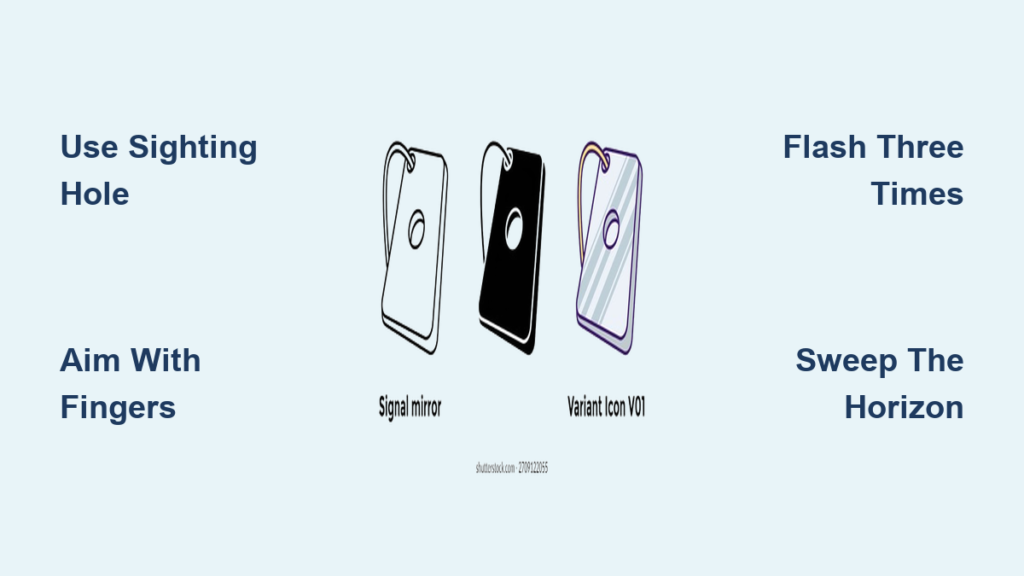
Selecting the proper mirror is the first critical step. Dedicated signal mirrors designed for emergency use include a central sighting hole that dramatically improves aiming accuracy. The standard 2 x 3-inch size offers the optimal balance between reflectivity and portability.
Glass mirrors provide superior reflectivity and can be seen up to 50+ miles under ideal conditions, making them the best choice for long-range signaling. However, they are fragile and require storage in a padded case or Bubble-Wrap sleeve. Plastic acrylic mirrors are lighter and shatter-resistant but less reflective, suitable for general use and available for as little as $3 to $5.
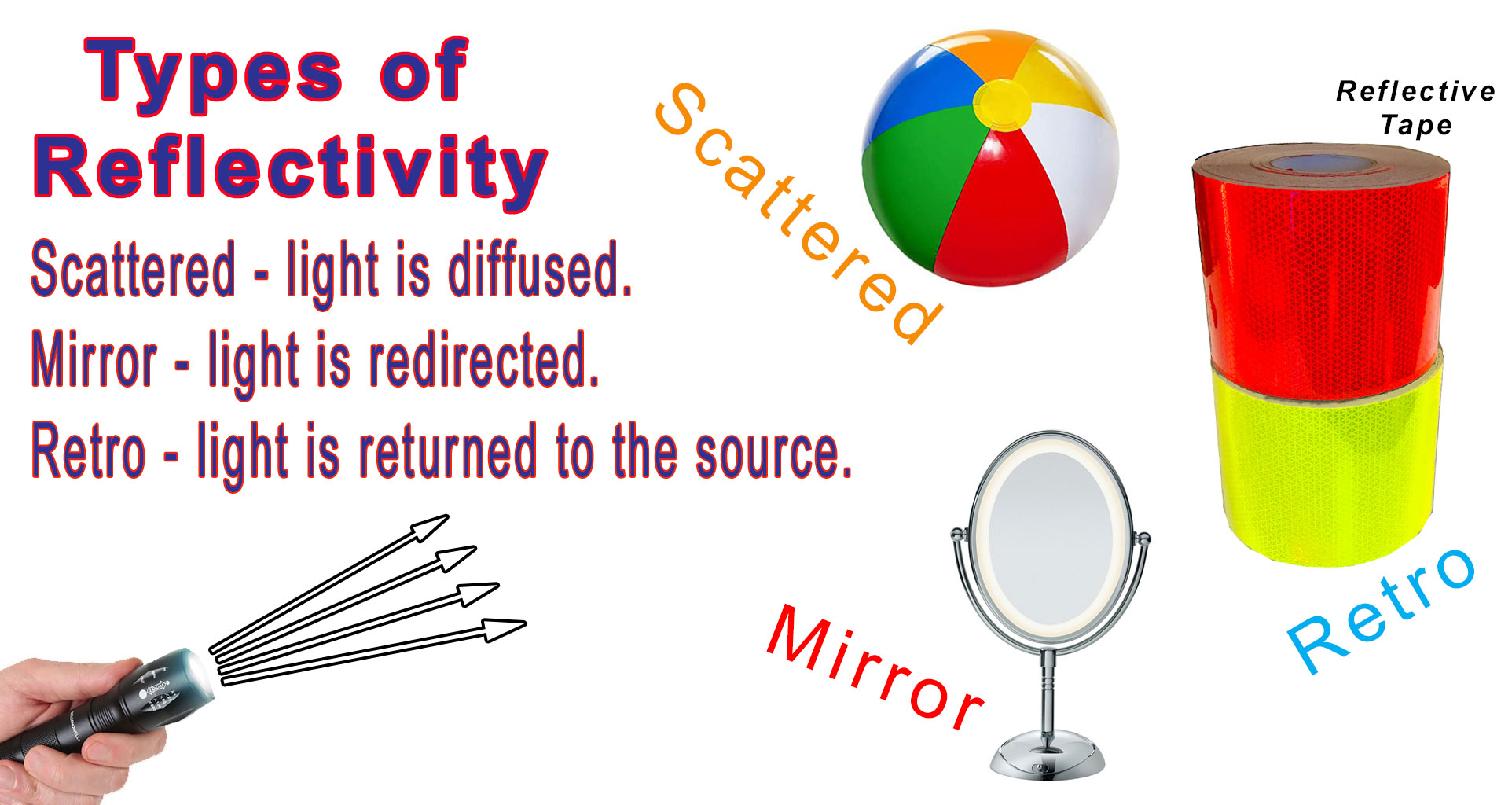
Look for models with a retroreflective grid around the sighting hole. This feature shows you exactly where the beam is going before it hits the target, even under stress. The Coghlan’s Featherweight Mirror is a popular affordable option.
If a dedicated mirror is unavailable, nearly any shiny surface can work in an emergency. Smartphone screens, compact makeup mirrors, credit cards with metallic finishes, aluminum foil, watch faces, CDs, and stainless steel utensils all reflect some light. The limitation is that improvised mirrors lack aiming aids and degrade quickly in effectiveness.
Position Yourself for Maximum Signal Effectiveness
A signal mirror only works when exposed to direct sunlight. Move out of shade caused by trees, rocks, or overhangs immediately. Even partial cloud cover reduces effectiveness, though scattered beams may still work on bright overcast days.
Ensure your target is in sunlight too. If you are in the sun but the aircraft or boat is in shadow, the contrast drops significantly, making your flash harder to see. This positioning matters more than most people realize.
Hold the mirror within 6 inches of your eye when aiming. This minimizes parallax error and lets you guide the reflection using visual feedback from your hand or fingers. Avoid holding it at arm’s length unless sweeping the horizon, because accuracy suffers without a reference point.
Master the Sighting Hole Technique for Accurate Aiming
This is the most accurate method for dedicated signal mirrors with a central hole.
First, hold the mirror close to your eye, aligning the sighting hole with your pupil. Extend your non-dominant hand and form a V with your index and middle fingers, pointing directly at your target such as an aircraft or distant boat.
Next, tilt the mirror until sunlight reflects through the V of your fingers. Keep the reflection steady on the target and flash three times by slightly tilting the mirror away and back. Repeat the sequence until you receive acknowledgment, such as an aircraft banking turn or circling.
The sighting hole ensures the reflected beam travels along your line of sight. You are not aiming the mirror, you are guiding the reflected beam using your fingers as a reference.
If your mirror has a retroreflective grid, adjust it until a bright spot appears in the grid and overlaps your target. This visual cue makes aiming faster and more precise, especially under stress.
Signal Without a Sighting Hole Using Alternative Methods
If your mirror lacks a sighting hole, such as a compass back or improvised surface, you can still signal effectively. Reflect sunlight onto your hand or arm first, then slowly raise the mirror toward your eye while keeping the reflection visible.
Once near your face, tilt the mirror toward the sun until you see a small bead of light in the mirror. Move the bead toward your target while maintaining visual contact. Flash three times by covering and uncovering the mirror or tilting it slightly.
An alternative method involves holding two fingers in a V and angling the mirror so the reflection passes between them. Adjust until the light hits your target.
Handle Difficult Sun Angles and Positions

When the sun is behind you and the target is ahead, direct reflection becomes tricky. Point your V-shaped hand 90 degrees or more to the left or right of the target. Position the mirror so sunlight reflects off your fingertips, then rotate both hands together while keeping the fingertip reflection aligned with the target. Flash three times once locked in.
This indirect method often works better than trying to reflect light straight ahead.
If the target is behind you and the sun is in front, lie on your back and hold the mirror above your face. Use your outstretched arm and fingers to guide the reflection backward. This position allows you to bounce sunlight where your body would otherwise block it.
Sweep the Horizon to Find Rescue Aircraft
If you have not spotted rescuers but suspect they may be nearby, hold the mirror at arm’s length and slowly sweep the horizon in wide arcs. Reflect sunlight across the sky and pause briefly every few seconds to allow flashes to be noticed.
Focus on valleys, rivers, flight corridors, or open water, which are common search paths. Aircraft and boats often approach from predictable directions, so sweeping increases the chance of catching a moving observer’s eye even if they are outside your visual range.
Aircrews are trained to scan at 20 degrees per second. A persistent, flashing signal will likely be detected during their sweep.
Signal an Aircraft Effectively for Maximum Visibility
Pilots see best through cockpit windows. Aim your flash at the front of the aircraft for the highest chance of detection. Do not aim at the wings or tail, because those areas reflect ambient light and will not draw attention.
Aircraft move fast, and a stationary flash may last only a fraction of a second in the pilot’s field of view. Once your reflection hits the plane, sweep the beam left to right across its path. This creates a moving flash that is far more noticeable than a static one.
Send the SOS flash pattern by making three short flashes for S, three long flashes for O, and three short flashes again. Pause 5 to 10 seconds, then repeat. Use controlled tilting to turn the reflection on and off precisely.
In a Grand Canyon rafting incident, a survivor’s companion spelled SOS with the mirror, and a commercial jet at 35,000 feet spotted it, triggering an emergency rescue. While SOS is effective, three flashes alone are universally recognized and easier to remember under stress.
Use a Signal Mirror Safely on Water
On calm water, sunlight creates sun glitter, a shimmering effect that can mask your signal. Keep the mirror high above the waterline, either overhead or on a pole. Avoid low-angle signaling near the horizon.
Use slow, deliberate sweeps so the flash contrasts with random glints. Flash in SOS pattern to distinguish your signal from natural reflections. On clear days, even small reflections can be seen from 10+ miles over water due to minimal atmospheric interference.
Know When NOT to Use a Signal Mirror
A signal mirror fails under heavy overcast or stormy skies, at nighttime, under dense forest canopy, and in fog, blizzard, or smoke. These conditions block or diffuse sunlight enough to make signaling useless.
Alternative methods include whistles (three blasts for distress), flares for day or night use, smoke signals for daytime only, flashlights or strobes for night use with SOS pattern, and ground markers arranged in X or SOS shape at least 30 feet long.
Combine Signals for Better Rescue Chances
Wear bright orange, red, or yellow clothing to avoid blending into terrain. If bright clothing is not available, deploy ground signals using an orange emergency shelter, a shiny Mylar blanket, or a tarp arranged in a large X or V shape.
Combine multiple signals for layered communication. Use mirror plus whistle, smoke plus ground marker, or fire plus strobe light. Multi-modal signaling increases detection chances across different conditions and times of day.
Avoid These Common Mistakes
The most frequent mistake is aiming the mirror instead of the reflection. Guide the reflected beam using fingers or the sighting hole. Another common error is moving too quickly; use slow, controlled sweeps for clear flashes.
Do not hold the mirror too far from your face; keep it within 6 inches of your eye for accuracy. Always use a reference point such as fingers, the hole, or the frame to guide the light. Finally, do not give up too soon. Signal for 30 to 60 seconds and repeat in cycles. Rescuers may not see the first flash, but the tenth might save you.
Store and Maintain Your Signal Mirror Properly
Keep the mirror clean and scratch-free because damaged surfaces scatter light and reduce effectiveness. Store in a padded sheath or protective case. Avoid exposure to sand, grit, or moisture.
Inspect regularly for cracks or clouding. Many service-issued mirrors have printed instructions on the back for emergency reference.
Carry Your Signal Mirror Where It Is Accessible
A signal mirror is useless if buried in your pack. Carry it where you can grab it without unpacking gear. Good locations include your wallet, keychain, zipper pull on backpack or jacket, Altoids tin survival kit, belt pouch, lifejacket pocket for boaters, or backpack strap clip.
This accessibility is especially critical in water emergencies.
Practice These Essential Techniques Before You Need It
Never wait for an emergency to learn how to use a signal mirror. Practice regularly by signaling a friend across a field using three-flash sequences. Test different sun angles and improvised mirrors. Simulate aircraft approaches by aiming at moving cars or drones.
Train with a partner for feedback on accuracy. Test multiple mirrors to compare brightness, ease of use, and range. Even small differences matter when it counts.
The ability to use simple tools effectively under stress often determines survival outcomes. Methodical preparation and rehearsed improvisation make the difference between life and death.
Frequently Asked Questions About Signal Mirrors
How far can a signal mirror be seen?
Under optimal conditions, a signal mirror can be seen from 5 to 10 miles on the ground and 20+ miles by aircraft. Range depends on mirror quality, sunlight intensity, and visibility conditions.
Do signal mirrors actually work in real rescue situations?
Yes. Documented rescues include a Grand Canyon survivor spotted by a jetliner at 35,000 feet. Signal mirrors are widely recognized as one of the most effective non-electronic signaling tools available.
Is a signal mirror better than a flashlight?
During daylight, a signal mirror is far more visible over long distances. At night, a flashlight or strobe is superior. Both should be part of a complete survival kit.
Can I use my phone as a signal mirror?
A smartphone screen can reflect sunlight and function as an emergency mirror. However, it lacks durability, precision, and retroreflective aiming aids.
Do signal mirrors work on cloudy days?
They are much less effective. Overcast skies diffuse sunlight, reducing reflection intensity. Use alternative methods like whistles or ground markers instead.
Can a signal mirror start a fire?
Only under very specific conditions with intense sun, perfect focus, and flammable tinder. It is not reliable and not designed for fire starting.
Key Takeaways for Mastering Signal Mirror Use
A signal mirror is one of the most reliable, lightweight, and effective survival tools you can carry. It weighs almost nothing, fits in your wallet, and can turn an invisible person into a clear target for rescue from hundreds of miles away.
The most important elements are choosing a mirror with a sighting hole, practicing the aiming technique before you need it, and persisting for at least 30 to 60 seconds before giving up. Combine your mirror with bright clothing, ground markers, and whistle signals for maximum visibility.
Carry it always, protect it from damage, and practice with it regularly. When the moment comes, let the sun do the talking.